
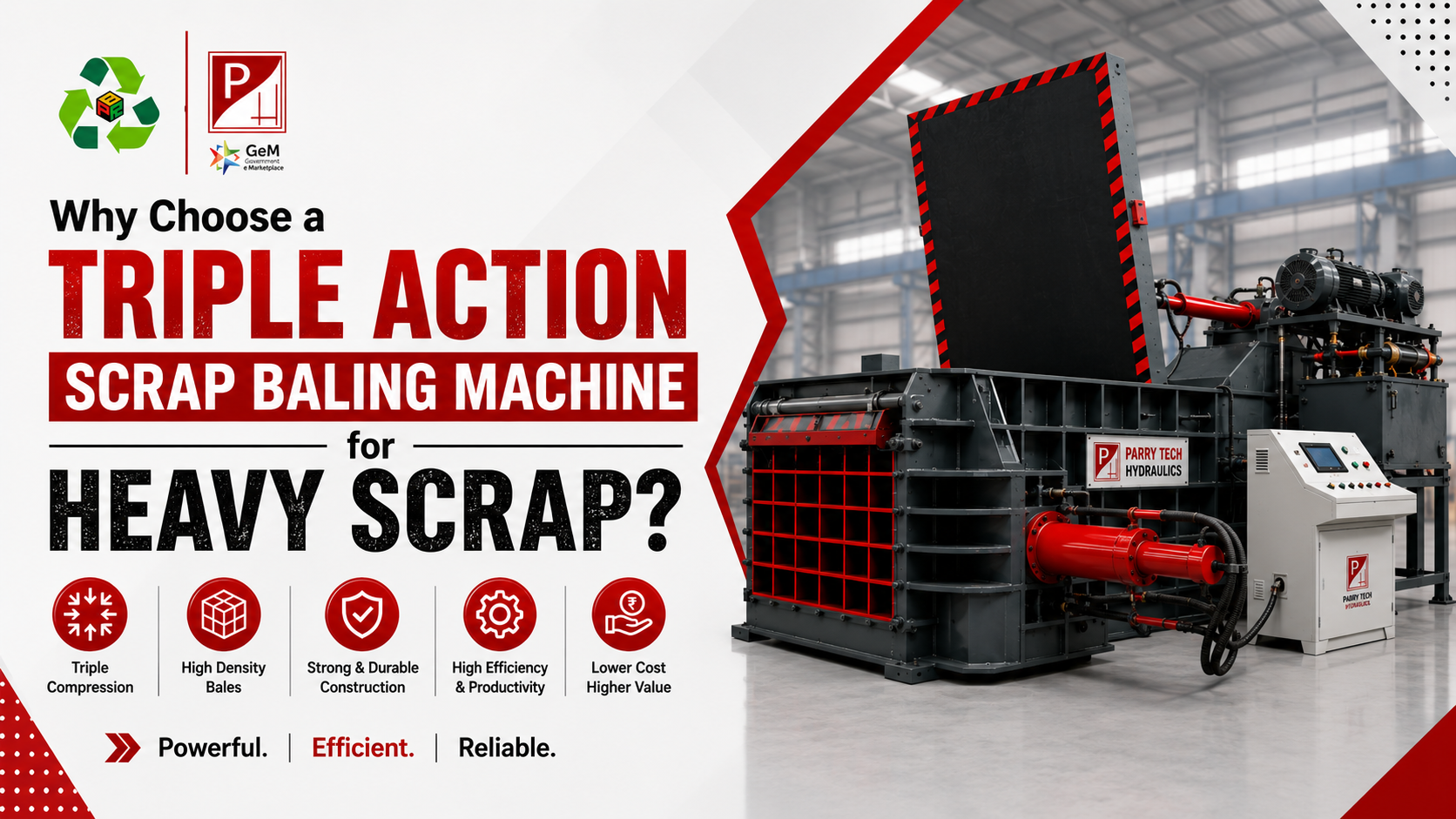
Heavy scrap can quickly become difficult to store, handle, and transport when it remains loose. Large metal pieces, fabrication offcuts, aluminium waste, and industrial scrap often take up more space because they do not stack efficiently. A Triple Action Scrap Baling Machine addresses this problem by using multiple hydraulic movements to compress scrap into dense, manageable bales.
For recycling plants, fabrication units, automobile industries, and large manufacturing facilities, the choice of baling machine should be based on scrap type, daily quantity, bale requirements, available space, and production workflow. Businesses searching for a Triple Action Scrap Baling Machine in Delhi should also consider the hydraulic system, chamber size, cylinder arrangement, automation, bale ejection, and after-sales support before selecting a machine.
What Is a Triple Action Scrap Baling Machine?
A triple-action scrap baling machine uses multiple hydraulic actions during the compression and ejection process. Instead of relying on a single pressing movement, the machine coordinates different hydraulic cylinders to compress the scrap and handle the finished bale.
This arrangement is particularly useful for heavy industrial scrap because the material can be bulky, irregular, and difficult to compact using simpler systems. The exact function of each hydraulic action depends on the machine design. In Parrytech Hydraulics’ Tripple Action Horizontal Scrap Baling Machine, the published configuration includes five cylinders and an ejector-cylinder tilting ejection system.
The machine is designed for automatic hydraulic operation and is intended for industrial scrap-baling applications where consistent compression and organized bale handling are important.
Why Is Triple Action Useful for Heavy Scrap?
1. Better Compression Control
Heavy scrap usually contains pieces with different shapes and sizes. When loose material is loaded into the chamber, empty spaces can remain between pieces.
Multiple hydraulic actions help manage the compression process and allow the machine to compact the material more effectively. The final bale density depends on the scrap material, loading pattern, hydraulic pressure, and machine configuration.
This is why heavy scrap-processing facilities generally need equipment designed specifically for the material rather than a basic baler selected only by price or nominal capacity.
2. Suitable for High Scrap Volumes
Industrial plants can generate large quantities of scrap every day. A machine designed for regular hydraulic baling can help convert this loose waste into standardized bales instead of allowing it to accumulate around the production area.
Parrytech’s published Tripple Action Horizontal Scrap Baling Machine has a 1880 × 962 × 700 mm compression chamber, 50 HP motor, 3300 PSI working pressure, and 1000-litre oil tank. These specifications indicate a heavy-duty industrial configuration intended for substantial scrap-handling applications.
3. Compact Bale Formation
One of the main reasons companies invest in hydraulic baling equipment is to reduce the space occupied by loose scrap.
Compacting scrap into bales can help:
- Reduce storage requirements
- Improve scrap-yard organization
- Make stacking easier
- Simplify material handling
- Improve loading and transportation arrangements
The actual degree of compaction depends on the material and operating conditions, so bale performance should be evaluated using the customer’s actual scrap.
4. Easier Bale Handling
After compression, the finished bale needs to be removed from the machine. Efficient ejection is therefore an important part of the overall baling cycle.
Parrytech’s published Tripple Action machine uses an ejector-cylinder tilting ejection system, which is designed to assist in removing the completed bale from the chamber.
For a busy industrial operation, an effective ejection arrangement can help maintain a smoother workflow between loading, compression, and bale removal.
What Heavy Scrap Can Be Processed?
The exact material suitability depends on the machine configuration, but heavy hydraulic scrap balers can be used for suitable metal and industrial scrap such as:
- Mild steel scrap
- Aluminium scrap
- Sheet-metal offcuts
- Fabrication scrap
- Industrial metal waste
- Production rejects
- Suitable recyclable metal pieces
Material preparation may still be required when scrap pieces are excessively large, long, or irregular.
For example, MS scrap and aluminium behave differently during compression. Parrytech’s published specifications indicate approximate bale weights of 60–120 kg for MS and 40–45 kg for aluminium, demonstrating that final bale characteristics depend on the material being processed.
Important Features to Check Before Buying
Hydraulic Pressure
Pressure must be sufficient for the type and density of scrap being compressed. Parrytech lists a working pressure of 3300 PSI for its published Tripple Action Horizontal Scrap Baling Machine.
Compression Chamber
The chamber size determines the quantity and dimensions of scrap that can be loaded during a cycle. Always compare the chamber with the actual scrap size generated at your facility.
Number of Cylinders
Cylinder arrangement affects compression and ejection. Parrytech’s published machine uses five cylinders, with multiple hydraulic actions integrated into the baling process.
Motor Capacity
Heavy-duty baling requires a hydraulic power unit capable of supporting the required cycle. The published Parrytech configuration uses a 50 HP motor.
Control System
Automatic operation can be particularly useful when scrap is processed regularly. PLC and HMI-based controls can help operators manage the machine sequence and monitor the operating process.
Bale Weight and Dimensions
Bale weight and size affect storage, lifting, transportation, and downstream recycling. These specifications should be finalized according to the customer’s material and handling system.
Triple Action vs Standard Baling Machine
A standard baler may be sufficient for smaller quantities or lighter recyclable materials. A triple-action configuration becomes more attractive when the application involves:
- Heavy metal scrap
- Larger scrap quantities
- More demanding compression
- Regular industrial production
- Controlled bale ejection
- Higher levels of hydraulic automation
The additional hydraulic actions should, however, have a practical purpose. The best machine is not necessarily the one with the most cylinders; it is the one whose hydraulic configuration matches the scrap and production process.
Why Choose Parrytech Hydraulics?
Parrytech Hydraulics is a hydraulic machinery manufacturer based in Mundka Industrial Area, New Delhi. The company’s product range includes hydraulic presses, scrap baling machines, deep-drawing presses, moulding presses, shearing machines, bending machines, and other industrial hydraulic equipment.
Its baling range includes Automatic Hydraulic Baling Presses, Continuous Baling Machines, Double Action Hydraulic Scrap Baling Presses, Four Side Compression Hydraulic Baling Machines, Horizontal Paper Balers, and Tripple Action Baling Machines.
This experience across different hydraulic and recycling machines is valuable when the customer is dealing with heavy or mixed industrial scrap. Scrap characteristics can vary significantly between manufacturing plants, so machine selection should be based on actual material, daily scrap generation, bale requirements, and available installation space.
Parrytech also provides installation and commissioning, machine testing, operator training, repair and maintenance, upgrades, and breakdown support. For heavy-duty hydraulic equipment, these services are important because correct installation, hydraulic settings, routine inspection, and maintenance can directly affect machine reliability.
For businesses looking for a Triple Action Scrap Baling Machine in Delhi, working directly with a manufacturer can make it easier to discuss the scrap type, required compression, chamber dimensions, bale weight, ejection method, electrical requirements, and installation conditions before the machine is finalized.
Is Triple Action Right for Your Business?
A triple-action baler may be worth considering when your facility:
- Generates substantial quantities of heavy scrap
- Needs compact and manageable bales
- Wants a more organized scrap-handling process
- Requires automatic hydraulic operation
- Needs controlled bale ejection
- Has sufficient installation space
- Wants a machine designed around its specific scrap characteristics
However, smaller operations producing limited quantities of light scrap may not require the same configuration.
What Should You Tell the Manufacturer?
Before ordering, provide the manufacturer with practical information such as:
Scrap material → average daily quantity → largest scrap-piece size → desired bale dimensions → required bale weight → available space → loading method → bale-handling arrangement.
This information allows the manufacturer to determine whether a triple-action machine is appropriate and what hydraulic configuration should be used.
Final Thoughts
A Triple Action Scrap Baling Machine can be a strong solution for heavy industrial scrap because it combines multiple hydraulic actions with controlled compression and bale ejection. It can help reduce the space occupied by loose scrap, improve storage organization, and make handling and transportation more practical.
Still, the machine should not be selected only because it is labelled “triple action.” Hydraulic pressure, chamber size, cylinder arrangement, motor capacity, bale specifications, automation, and scrap characteristics all influence the final result.
For industries searching for a Triple Action Scrap Baling Machine in Delhi, Parrytech Hydraulics provides hydraulic baling equipment designed for industrial applications and can configure machinery around specific production and scrap-handling requirements.
FAQs
1. What is a Triple Action Scrap Baling Machine?
It is a hydraulic baler that uses multiple hydraulic actions for controlled scrap compression and bale ejection.
2. Is it suitable for heavy metal scrap?
Yes. It can be suitable for heavy industrial scrap when the hydraulic capacity and chamber are correctly matched to the material.
3. Can aluminium scrap be baled?
Yes. Suitable aluminium scrap can be compressed, with bale characteristics depending on material density and machine settings.
4. Does it reduce scrap storage space?
Yes. Compressing loose scrap into compact bales can significantly improve storage and stacking efficiency.
5. Can Parrytech provide a customized baling machine?
Yes. The machine configuration can be selected according to the scrap material, bale requirements, production volume, and application.

Leave A Comment