
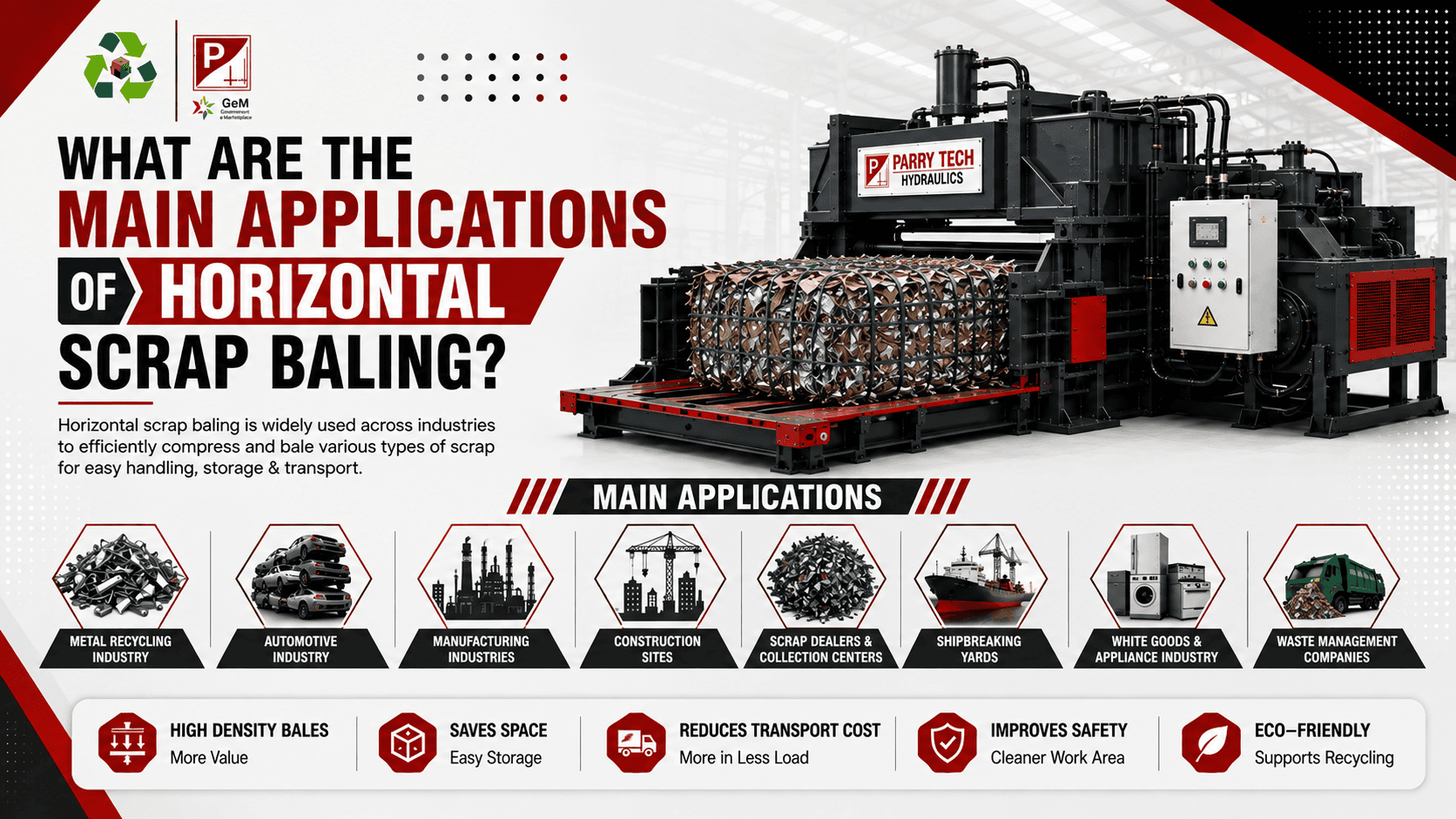
Scrap does not become difficult to manage only because there is a lot of it. The real problem starts when different pieces of metal begin piling up without any proper handling system. Sheet cuttings, aluminium pieces, fabrication waste and manufacturing offcuts can quickly spread across the work area, occupy storage space and make internal transportation harder.
This is where horizontal scrap baling becomes useful. Instead of keeping recyclable material loose, a hydraulic baling machine compresses it into compact bales that are easier to shift, store and send for further recycling. The applications are especially relevant for industries where scrap is generated continuously throughout the production process.
For companies considering a Horizontal Scrap Baling Machine in Delhi, the machine should be selected according to the kind of scrap being generated and the way that scrap moves through the factory.
Where Is Horizontal Scrap Baling Actually Used?
Horizontal baling is not limited to scrap dealers. It can become part of the material-handling process in several manufacturing and recycling environments.
Metal Recycling Facilities
Recycling plants often receive scrap in loose and irregular forms. Before the material is transported or processed further, it may need to be consolidated.
A horizontal baler can turn loose metal into manageable bales, making the scrap yard easier to organize. Instead of handling hundreds of individual pieces, workers can deal with compact units that can be moved with suitable lifting equipment.
For recycling operations, bale consistency is also useful because material can be sorted, stored and dispatched in a more structured manner.
Automobile Manufacturing Units
Automobile production generates a considerable amount of metal scrap from cutting, stamping, trimming and fabrication processes. These offcuts may include different shapes and sizes.
Keeping such scrap loose near the production line is inefficient. A baling system can be placed into the plant’s waste-handling workflow so that collected scrap is compressed periodically.
The final bale size and weight should be decided around the plant’s existing forklifts, cranes, storage areas and transportation arrangements.
Sheet-Metal and Fabrication Industries
Fabrication workshops produce metal leftovers almost continuously. Cutting machines, shearing equipment, punching operations and fabrication work can all generate reusable scrap.
The challenge is that sheet-metal offcuts rarely stack neatly. A horizontal baler gives the plant a way to consolidate suitable pieces instead of allowing them to accumulate randomly.
This can also improve housekeeping around the production area, particularly where floor space is limited.
Aluminium Scrap Processing
Aluminium scrap is lighter than steel, but a large quantity of loose aluminium can still consume significant storage space.
A suitable horizontal baling system can compress aluminium pieces into compact units. Parrytech Hydraulics’ published Tripple Action Horizontal Scrap Baling Machine gives an example of how bale characteristics change by material: its stated approximate bale weight is 40–45 kg for aluminium, compared with 60–120 kg for MS scrap.
That difference is important when planning storage and handling equipment. Bale requirements should therefore be discussed based on the actual material rather than assuming one standard bale weight.
Industrial Scrap Collection
Large factories may generate scrap from several departments rather than a single production line. Without a central handling method, scrap can end up stored in different locations.
A horizontal baler can support a more organized collection system by receiving suitable scrap at planned intervals and converting it into compact units.
This approach is particularly useful when scrap generation is continuous and the company wants to move material away from production areas without creating large loose piles.
Scrap Dealers and Aggregators
Scrap dealers need to receive, sort, store and dispatch material efficiently. Compact bales can simplify the process by converting loose material into standardized units.
The right bale dimensions depend on downstream buyers and available transportation. A machine should therefore be selected only after considering the required bale size, weight and handling method.
Why Horizontal Design Matters
A horizontal configuration is particularly relevant to larger industrial operations because the material is loaded into a horizontal compression chamber and the finished bale is handled through the machine’s ejection arrangement.
The Parrytech Triple Action Horizontal Scrap Baling Machine, for example, has a stated chamber size of 1880 × 962 × 700 mm, a 50 HP motor, 3300 PSI working pressure, a 1000-litre oil tank, and five cylinders. It is listed for automatic operation with PLC + HMI-based control options.
These specifications also show why buying a baler should involve more than comparing hydraulic pressure. The chamber, motor, cylinder arrangement, controls and ejection system all have a role in how the machine fits into an industrial workflow.
What Happens After the Scrap Is Baled?
The value of baling is not limited to compression. The bale becomes a practical handling unit.
A properly planned baling process can make it easier to:
Collect → compress → move → stack → store → transport → recycle
For a recycling-oriented operation, this can simplify the movement of material from production areas to the scrap yard and eventually to the next stage of processing.
However, the machine should not be expected to solve every scrap-handling problem. Oversized pieces may require cutting or preparation, and contaminated or unsuitable materials may need to be separated before loading.
Choosing the Machine Around the Application
The best horizontal baler is the one that matches the scrap actually generated by the plant.
Before selecting a machine, a manufacturer should look at:
- What material is produced?
- How much scrap is generated each day?
- What is the approximate piece size?
- Is the scrap mainly steel, aluminium or another recyclable material?
- What bale weight is required?
- What bale dimensions are convenient?
- How will the bale be lifted?
- Where will the machine be installed?
- Is automatic operation required?
This is where practical engineering experience becomes important. A machine designed around the actual scrap and handling process is more useful than simply selecting the largest available model.
Parrytech Hydraulics for Industrial Baling
Parrytech Hydraulics manufactures hydraulic and recycling machinery from Mundka Industrial Area, New Delhi. Its product portfolio includes several types of baling equipment alongside hydraulic presses, deep-drawing machinery, moulding presses, bending machines and other industrial equipment.
The company’s listed baling range includes Four Side Compression Hydraulic Baling Machine, Automatic Hydraulic Baling Press, Double Action Hydraulic Scrap Baling Press, Continuous Baling Machine, Horizontal Paper Baler and Tripple Action Baling Machine.
That range is useful for customers because scrap-handling requirements are not identical. A facility processing heavy metal scrap may need a very different arrangement from one compacting paper or other lighter recyclable material.
Parrytech also highlights custom hydraulic system design, installation and commissioning, machine testing and training, along with repair, maintenance, upgrades and breakdown support.
For a company looking for a Horizontal Scrap Baling Machine in Delhi, these practical services can matter as much as the basic machine specification. Correct installation, hydraulic setup and operator understanding all contribute to dependable day-to-day use.
When Is Horizontal Baling the Better Choice?
Horizontal scrap baling is especially worth considering when:
- Scrap generation is regular and substantial.
- Loose material is consuming too much floor space.
- Manual scrap handling is becoming difficult.
- Compact bales are easier to store or transport.
- The factory needs a more organized recycling workflow.
- Automatic hydraulic operation would improve productivity.
- The finished material needs to be handled using forklifts, cranes or other lifting equipment.
For very small scrap quantities, a large industrial baler may not be necessary. The machine should always be matched to the actual volume and operating conditions.
Final Thoughts
Horizontal scrap baling has applications across metal recycling, automobile manufacturing, fabrication, aluminium processing, manufacturing plants and commercial scrap-handling operations.
Its real advantage is not simply compressing scrap. It is turning loose, difficult-to-handle material into compact units that fit better into a factory’s storage, handling and transportation system.
For industries evaluating a Horizontal Scrap Baling Machine in Delhi, the most useful starting point is the scrap itself. Its material, quantity, size, density and required bale format should determine the machine configuration.
Parrytech Hydraulics offers multiple hydraulic baling configurations and customized hydraulic solutions, allowing industrial buyers to discuss their actual scrap-handling requirements before finalizing the equipment.
FAQs
1. What industries use horizontal scrap baling?
Metal recycling, automobile, fabrication, manufacturing and scrap-processing industries commonly use horizontal baling.
2. Can aluminium and MS scrap be baled?
Yes, suitable aluminium and MS scrap can be processed with an appropriately configured hydraulic baler.
3. Does horizontal baling reduce storage problems?
Yes. Compact bales are generally easier to stack and manage than loose scrap.
4. Is automatic operation available?
Yes. Parrytech’s Tripple Action Horizontal Scrap Baling Machine is listed with automatic operation and PLC + HMI control options.
5. Can the machine be customized?
Parrytech provides customized hydraulic solutions according to industrial application and customer requirements.

Leave A Comment