
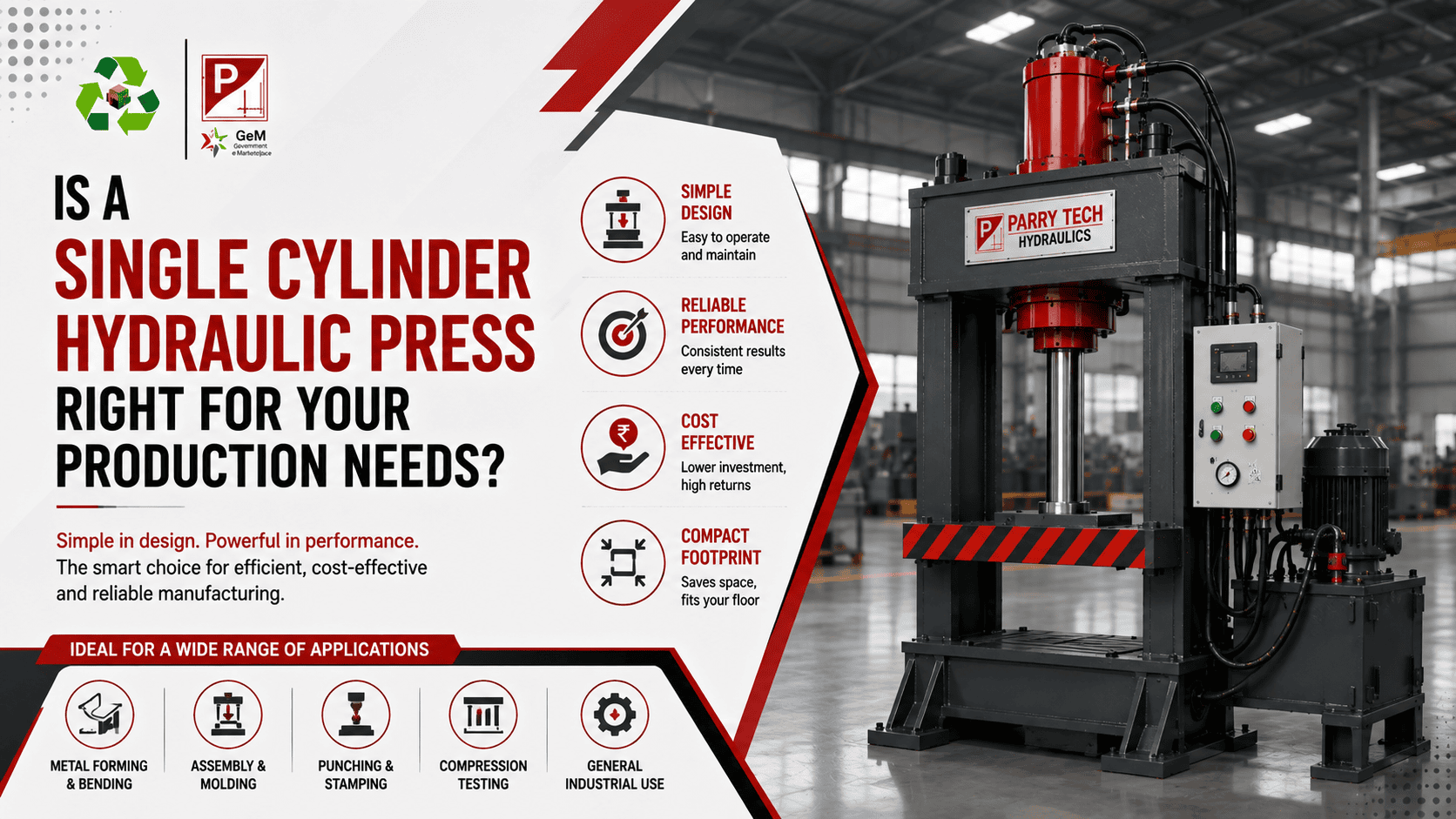
Choosing the right hydraulic press is an important decision for any manufacturing unit. The machine needs to provide sufficient force, suitable stroke, reliable hydraulic movement, and the right working area for the intended application. A Single Cylinder Hydraulic Press can be a practical choice for manufacturers who need straightforward and controlled pressing operations without the complexity of multiple-cylinder forming systems.
However, a single-cylinder configuration is not automatically suitable for every production process. The material, component size, required pressing force, tooling arrangement, production volume, and type of operation should be evaluated before selecting the machine. For businesses searching for a Single Cylinder Hydraulic Press in Delhi, understanding these factors can help determine whether this configuration matches their production requirements.
What Is a Single Cylinder Hydraulic Press?
A Single Cylinder Hydraulic Press uses one primary hydraulic cylinder to generate the pressing force required for the operation. Hydraulic oil is supplied to the cylinder through the hydraulic power unit, causing the ram to move and apply force to the workpiece.
The basic working principle is simple, but the machine can be designed for many different industrial applications. Depending on the configuration, a single-cylinder press can be used for pressing, straightening, punching, fitting, forming, moulding, and other operations.
For many straightforward applications, a single-cylinder arrangement can provide the required force without adding hydraulic movements that are not necessary for the production process.
How Does a Single Cylinder Hydraulic Press Work?
The operation starts by placing the workpiece or material on the press bed. Once the machine is activated, hydraulic oil is directed toward the cylinder.
The cylinder extends and moves the ram toward the workpiece. The ram applies controlled hydraulic force to perform the required operation. After the pressing cycle is completed, hydraulic pressure is controlled to return the ram to its starting position.
The exact operating sequence depends on the machine design and application. Factors such as cylinder capacity, hydraulic pressure, stroke, bed dimensions, and control system determine how effectively the machine performs the required task.
In practical machine selection, the most important point is matching the cylinder capacity and machine configuration with the actual production requirement rather than selecting equipment simply because it has a higher tonnage.
When Is a Single Cylinder Press a Good Choice?
1. When the Operation Is Straightforward
A single-cylinder press can be suitable when the production process mainly requires one controlled pressing movement.
Applications such as pressing, straightening, fitting, compacting, and simple forming may not require multiple hydraulic actions. In these situations, a single-cylinder configuration can provide the necessary force while keeping the machine arrangement relatively straightforward.
2. When Controlled Hydraulic Force Is Required
Hydraulic systems provide controlled pressing force, which can be useful when the workpiece needs a gradual or controlled application of pressure.
This is particularly helpful for operations where excessive or uncontrolled force could damage the component, tooling, or material.
3. When Production Does Not Require Multi-Action Forming
Double-action and triple-action presses are useful when the manufacturing process requires separate hydraulic movements, such as main-ram and blank-holder control.
If your component does not require these additional movements, a single-cylinder press may be sufficient. The machine should be selected according to the actual process rather than choosing a more complicated configuration without a production need.
4. When Space and Layout Matter
Machine dimensions should always be considered before installation. The press needs enough space for loading, unloading, operator movement, maintenance, and tooling.
A suitable single-cylinder configuration can be considered when the production layout does not require a large multi-action pressing system.
Applications of Single Cylinder Hydraulic Press
A single-cylinder hydraulic press can be used for various industrial operations, depending on its capacity and tooling. Common applications may include:
- Metal pressing
- Component straightening
- Bearing and bush fitting
- Simple sheet-metal forming
- Punching operations
- Compression applications
- Rubber and composite moulding
- General industrial pressing
- Assembly and dismantling operations
The exact application should be discussed with the manufacturer because cylinder capacity, stroke, bed size, daylight, and tooling requirements vary considerably between different jobs.
Parrytech Hydraulics manufactures a wide range of hydraulic equipment, including hydraulic presses, deep-draw presses, rubber moulding machines, transfer moulding units, baling machines, and customized hydraulic machinery. Its hydraulic deep-drawing range includes machines from 100 tons upward, with configurations designed around different applications and customer requirements.
Important Features to Check Before Buying
Press Capacity
The first specification to evaluate is the required pressing force. The machine capacity should be selected according to the material, component, tooling, and actual process requirement.
Choosing a machine with significantly more capacity than required may not be the most practical solution, while insufficient capacity can affect production and machine life.
Cylinder and Stroke
The cylinder should provide adequate force and stroke for the intended operation. Stroke is especially important when the ram needs to travel a specific distance to complete pressing or forming.
Bed Size
The press bed must accommodate the workpiece and tooling safely. Check the die or fixture dimensions before finalizing the machine.
Daylight
Adequate daylight is necessary for installing the tooling and allowing sufficient working clearance between the ram and bed.
Hydraulic System
The hydraulic power unit, pump, valves, oil tank, filtration, pressure controls, and cylinder all contribute to machine performance. These components should be selected according to the required operating cycle.
Control System
Depending on the production requirement, the press may use manual, semi-automatic, or PLC-based controls. For repetitive production, appropriate controls can make the operating cycle easier to manage consistently.
Single Cylinder vs Multi-Cylinder Press
The choice between a single-cylinder and multi-cylinder press depends mainly on the application.
A single-cylinder press is generally suitable when one primary pressing action is sufficient. It can be useful for straightforward pressing, fitting, straightening, and forming applications.
A multi-cylinder or multi-action press becomes more appropriate when the process requires additional force distribution or independently controlled movements.
For example, deep drawing may require a blank holder in addition to the main ram. In such a case, a double-action configuration may be more suitable than a basic single-cylinder arrangement.
Therefore, manufacturers should first identify the process and tooling requirements and then select the cylinder configuration.
Why Choose Parrytech Hydraulics?
Parrytech Hydraulics is a hydraulic machinery manufacturer based in Mundka Industrial Area, New Delhi. Its product portfolio covers hydraulic presses, deep-drawing presses, rubber moulding presses, transfer moulding units, baling machines, and other industrial hydraulic equipment.
The company focuses on customized hydraulic machinery, which is important because pressing requirements can differ significantly between industries. The required tonnage, stroke, bed dimensions, hydraulic components, control system, and tooling arrangement should be considered according to the customer’s production process.
Parrytech’s published hydraulic press information demonstrates different capacity configurations and application-specific designs. Its deep-draw press range includes models from 100 tons to 1200 tons in the published table, while the company states that heavy-duty presses and higher capacities can be manufactured according to customer requirements.
For customers looking for a Single Cylinder Hydraulic Press in Delhi, discussing the actual component, material, pressing force, tooling, and production cycle with the manufacturer can help determine whether a single-cylinder configuration is suitable or whether a different hydraulic arrangement would provide better results.
The company’s Delhi manufacturing location also makes it convenient for customers to coordinate technical discussions, machine inspection, installation, commissioning, and service requirements.
How to Know If You Need a Single Cylinder Press?
Before purchasing, consider these questions:
- What material will be processed?
- What pressing force is required?
- How much stroke is needed?
- What are the workpiece dimensions?
- What tooling or die will be used?
- Is one primary pressing movement sufficient?
- What production quantity is expected?
- Is manual or automatic operation required?
- How much installation space is available?
- What maintenance and service support will be required?
If the production process requires only one controlled pressing movement, a single-cylinder hydraulic press can be a suitable solution.
Final Thoughts
A Single Cylinder Hydraulic Press can be the right choice when your production process requires controlled hydraulic force without additional forming movements. It can be used for a wide range of pressing, straightening, fitting, forming, moulding, and industrial applications.
The correct machine should be selected according to required force, stroke, bed size, daylight, material, tooling, production volume, hydraulic system, and control requirements.
For manufacturers searching for a Single Cylinder Hydraulic Press in Delhi, Parrytech Hydraulics can evaluate the application and develop a hydraulic press configuration according to the production requirement. The best approach is to share the component details and intended operation with the manufacturer before finalizing the machine.
FAQs
1. What is a Single Cylinder Hydraulic Press?
It is a hydraulic press that uses one primary cylinder to generate the required pressing force.
2. What is a single-cylinder press used for?
It can be used for pressing, straightening, fitting, forming, moulding, punching, and other industrial operations.
3. Is it suitable for deep drawing?
It depends on the application. Deep drawing may require additional blank-holder control, making a double-action configuration more suitable in many cases.
4. Can Parrytech customize hydraulic presses?
Yes. Parrytech states that its hydraulic presses can be manufactured according to customer requirements.
5. How do I select the right press?
Consider the required force, stroke, bed size, daylight, material, tooling, production cycle, and required hydraulic actions.

Leave A Comment