
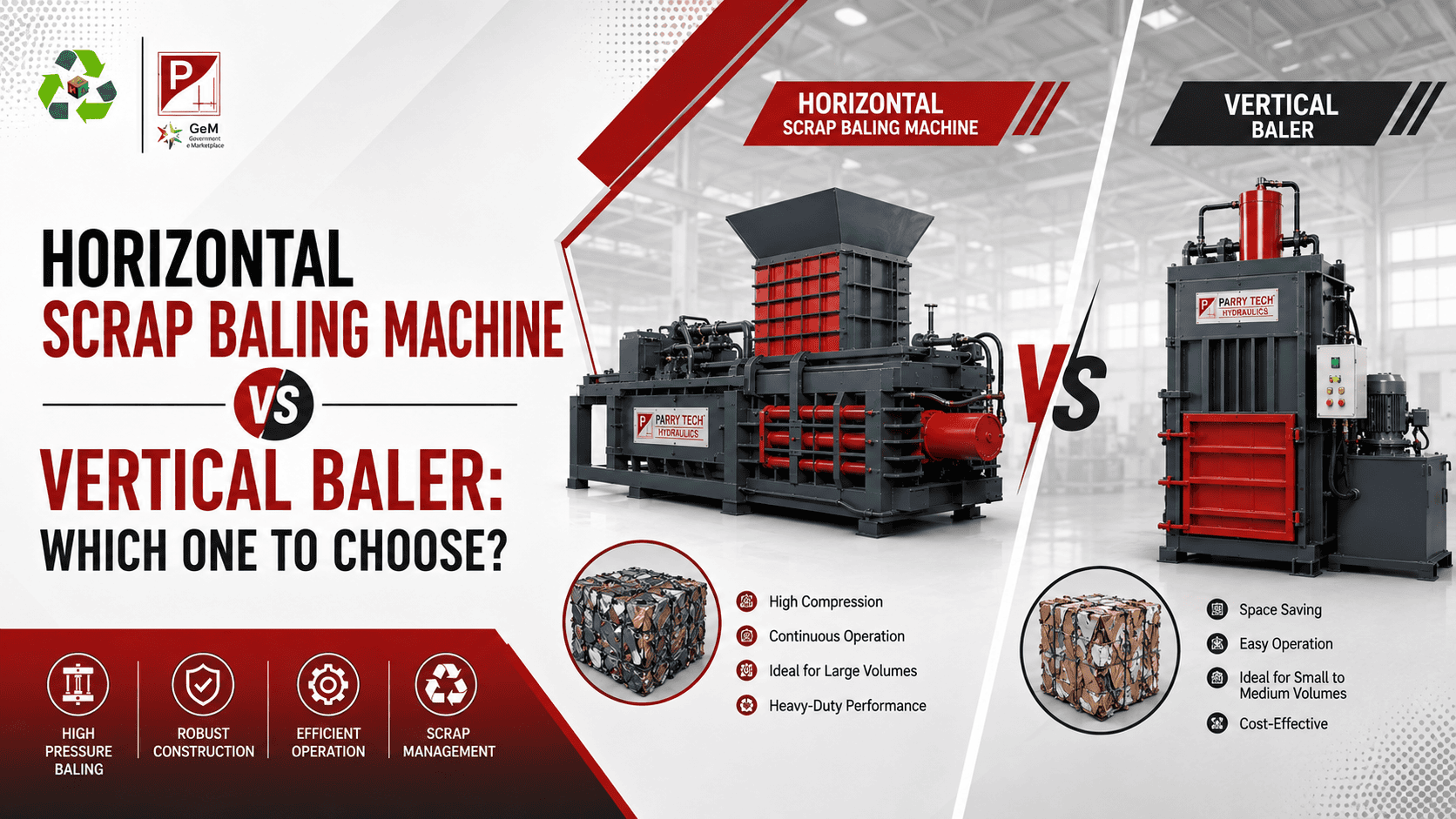
Managing scrap efficiently is an important part of modern recycling and manufacturing operations. Loose metal scrap, aluminium, industrial waste, paper, and other recyclable materials can occupy a large amount of space when they are not properly compressed. Baling machines solve this problem by compressing loose material into compact and manageable bales.
However, choosing between a Horizontal Scrap Baling Machine and a Vertical Baler depends on the type and quantity of scrap, available floor space, required bale size, operating method, and production volume. Understanding these differences can help industries select the right machine for their actual working conditions.
For businesses searching for the Best Horizontal Scrap Baling Machine in Delhi, Parrytech Hydraulics manufactures hydraulic baling equipment designed for industrial scrap-processing requirements.
What Is a Horizontal Scrap Baling Machine?
A Horizontal Scrap Baling Machine compresses scrap horizontally inside a large charging chamber. Hydraulic cylinders apply high pressure to compact the material, after which the finished bale can be ejected from the machine.
Horizontal machines are generally preferred for applications where a larger quantity of scrap needs to be processed regularly. Their horizontal chamber arrangement makes them suitable for feeding and processing substantial volumes of material.
Parrytech Hydraulics manufactures horizontal scrap baling machines with automatic operation and heavy-duty hydraulic construction. Its Tripple Action Horizontal Scrap Baling Machine, for example, has a chamber size of 1880 × 962 × 700 mm, a 50 HP motor, 3300 PSI working pressure, five cylinders, PLC + HMI-based control options, and an ejector-cylinder tilting ejection system.
These specifications show why machine selection should be based on actual scrap type, required bale weight, production quantity, and available infrastructure rather than simply choosing a machine based on its name.
What Is a Vertical Baler?
A Vertical Baler compresses material vertically inside a chamber. The hydraulic ram generally moves downward to compact the loaded material into a bale.
Vertical balers are often considered where floor space is limited and the material volume is relatively manageable. They can be useful for businesses handling paper, cardboard, plastic, textile waste, and certain types of light industrial scrap.
The loading and operating method is different from a horizontal machine, so the choice should depend on how frequently material is generated and how quickly the operator needs to process it.
Horizontal vs Vertical Baler: Main Differences
1. Scrap Volume
The amount of scrap generated daily is one of the first factors to consider.
A horizontal baler is generally more suitable for operations handling larger and continuous quantities of scrap. It can be integrated into a more production-oriented workflow where material is regularly loaded and compressed.
A vertical baler can be more practical for smaller operations where scrap is collected periodically rather than continuously.
2. Material Handling
Horizontal balers are useful when the recycling operation involves regular material feeding and higher throughput requirements. Depending on the machine design, loading can be arranged to suit the workflow.
Vertical balers normally require material to be loaded into the chamber from the top. This can be suitable for businesses where operators collect and load scrap in batches.
Before selecting the machine, the size, density, and condition of the scrap should be evaluated. Metal scrap behaves differently from paper or plastic, so the machine’s hydraulic force and chamber configuration need to match the material.
3. Bale Size and Density
The required bale size is another important consideration.
Industrial horizontal balers can be designed to produce specific bale dimensions and weights depending on the machine configuration and material. Parrytech’s horizontal scrap baling machine, for example, lists a bale size of 15 × 15 × variable and approximate bale weights of 60–120 kg for MS and 40–45 kg for aluminium.
This type of specification is useful when planning storage, transportation, and downstream recycling operations.
4. Floor Space
A vertical baler generally occupies less floor area because its working chamber is arranged vertically. This can make it attractive for facilities where floor space is restricted.
A horizontal scrap baler usually requires more installation space because of its longer machine structure. However, the additional space can be justified where the operation requires higher scrap-processing capacity and automated handling.
Therefore, the available installation area should always be measured before finalizing the machine.
5. Automation
Automation requirements can also influence the decision.
For higher-volume industrial operations, automatic hydraulic baling can reduce repetitive manual intervention and make the production process more organized. Parrytech’s horizontal scrap baling equipment includes automatic operation and PLC + HMI control options.
Vertical balers can also be selected for simpler operating requirements, particularly when the scrap volume does not justify a larger automated system.
When Should You Choose a Horizontal Scrap Baling Machine?
A horizontal machine can be the better choice when:
- Your facility generates a large quantity of scrap.
- Scrap processing is a regular industrial activity.
- Higher production capacity is required.
- You need consistent bale dimensions.
- You want a more automated hydraulic operation.
- The material includes heavy industrial scrap.
- Adequate installation space is available.
- Bale handling and transportation are important parts of your workflow.
For metal recycling plants, manufacturing facilities, scrap dealers, and larger industrial operations, a horizontal configuration can provide a practical solution for handling substantial scrap volumes.
When Is a Vertical Baler Better?
A vertical baler may be a better option when:
- Scrap generation is comparatively low.
- Available floor space is limited.
- Material is handled in smaller batches.
- The operation does not require very high throughput.
- The business needs a relatively compact baling setup.
- Paper, cardboard, plastic, or similar recyclable materials are being processed.
The right decision should always be based on the actual material and daily operating requirements.
Why Choose Parrytech Hydraulics?
Parrytech Hydraulics focuses on hydraulic machinery and recycling balers, with its manufacturing operations based in Mundka Industrial Area, New Delhi. The company states that its team includes experienced engineers and professionals who develop hydraulic solutions according to customer requirements.
One important advantage is customization. Industrial scrap varies considerably in material type, size, density, and quantity. A machine therefore needs to be selected according to the customer’s application. Parrytech’s product information highlights customized hydraulic equipment and different machine configurations for industrial requirements.
The company’s services also cover installation and commissioning, repair and maintenance, upgrades, breakdown support, and training. These services matter because correct installation, hydraulic settings, and regular maintenance directly affect machine performance and operating reliability.
For customers looking for the Best Horizontal Scrap Baling Machine in Delhi, working with a manufacturer that can understand the scrap material, required bale specifications, production volume, and available space can make the selection process more effective.
How to Choose the Right Baler?
Before purchasing a baling machine, consider these practical points:
- Identify the scrap material – MS, aluminium, paper, plastic, or mixed material.
- Calculate daily scrap generation – This helps determine the required production capacity.
- Decide the required bale weight and dimensions.
- Check available installation space.
- Consider manual or automatic operation.
- Evaluate hydraulic pressure and cylinder requirements.
- Check power requirements and electrical infrastructure.
- Consider bale ejection and material-handling arrangements.
- Ask about installation, maintenance, and after-sales support.
This approach helps prevent the common mistake of selecting a machine simply because it has a higher capacity than required.
Final Verdict: Horizontal or Vertical?
There is no single baler that is best for every business. A Vertical Baler can be a practical choice for smaller operations, limited spaces, and lower-volume recyclable materials. A Horizontal Scrap Baling Machine is generally more suitable for industrial operations that handle larger quantities of scrap and require higher processing capacity, consistent bales, and greater automation.
If your operation deals with substantial quantities of metal or industrial scrap, a horizontal hydraulic baler is worth considering. If space and scrap volume are limited, a vertical configuration may be more appropriate.
For businesses seeking the Best Horizontal Scrap Baling Machine in Delhi, Parrytech Hydraulics can help match the machine configuration to the material, bale requirements, production volume, and operating environment.
FAQs
1. Which is better, horizontal or vertical baler?
It depends on scrap volume, material, available space, and required production capacity.
2. What is a horizontal scrap baler used for?
It is mainly used for compressing larger quantities of industrial and recyclable scrap into compact bales.
3. Is a vertical baler suitable for small businesses?
Yes, vertical balers can be suitable where scrap volume and available operating space are relatively limited.
4. Does Parrytech manufacture horizontal scrap balers?
Yes, Parrytech manufactures hydraulic horizontal scrap baling machines for industrial applications.
5. Can Parrytech customize a baling machine?
Yes. The company provides customized hydraulic solutions according to customer requirements.

Leave A Comment