
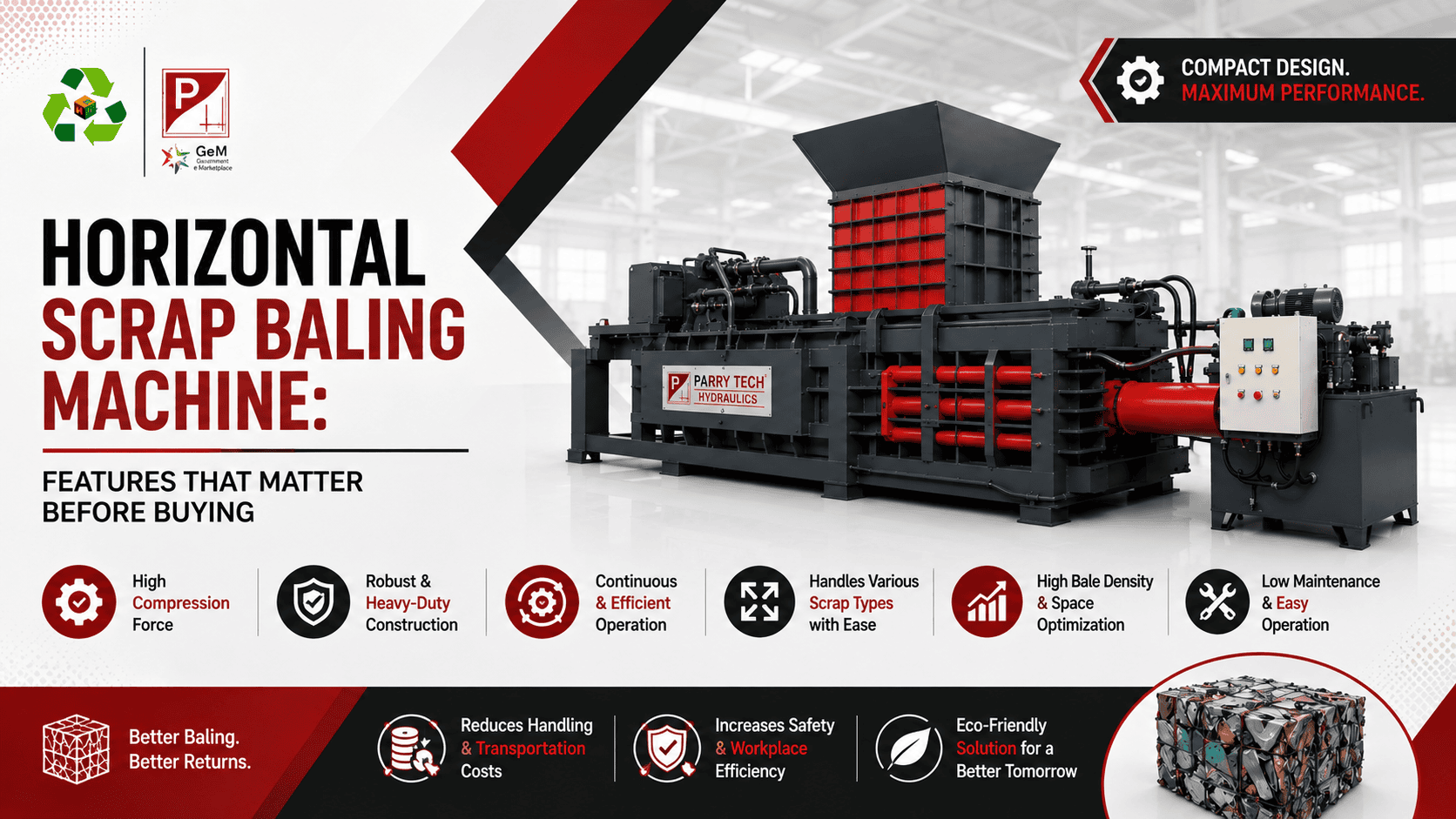
A Horizontal Scrap Baling Machine is an important piece of equipment for industries that handle large quantities of metal and recyclable scrap. Loose scrap can occupy considerable storage space, make material handling difficult, and increase the effort required for transportation. Hydraulic baling machines solve this problem by applying controlled pressure to compress scrap into compact, manageable bales.
However, buying a baling machine should not be based only on hydraulic pressure or machine size. The type of scrap, required bale weight, chamber dimensions, production volume, automation level, hydraulic system, and available installation space all affect the machine’s suitability. Businesses searching for a Horizontal Scrap Baling Machine in Delhi should therefore evaluate the complete machine configuration before making a decision.
What Is a Horizontal Scrap Baling Machine?
A horizontal scrap baling machine compresses loose scrap inside a horizontally arranged chamber using hydraulic cylinders. The material is loaded into the chamber, compressed under hydraulic force, and then ejected as a compact bale.
This configuration is particularly useful for industrial operations where scrap is generated regularly and needs to be processed efficiently. Depending on the machine design, automatic operation and controlled bale ejection can reduce repetitive manual work.
Parrytech Hydraulics manufactures horizontal scrap baling equipment for industrial applications. Its Tripple Action Horizontal Scrap Baling Machine has a chamber measuring 1880 × 962 × 700 mm, a 50 HP motor, 3300 PSI working pressure, a 1000-litre oil tank, five cylinders, and automatic operation with PLC + HMI control options.
1. Check the Hydraulic Pressing Capacity
Hydraulic force is one of the first specifications to check, but the required capacity should match the scrap material and application.
Heavy MS scrap, aluminium scrap, and lighter recyclable materials do not behave in exactly the same way during compression. Choosing a machine only because it has a high hydraulic capacity may not provide the most suitable solution.
The manufacturer should understand the type, size, density, and quantity of scrap before recommending the appropriate machine configuration.
2. Pay Attention to Chamber Size
The chamber determines how much material can be loaded and influences the resulting bale dimensions.
For example, Parrytech’s horizontal machine uses an approximately 1880 × 962 × 700 mm chamber and produces a bale size of 15 × 15 × variable, according to its published specifications.
Before buying, compare the chamber dimensions with the size and type of scrap generated at your facility. Oversized material may require additional preparation before loading.
3. Consider Bale Weight and Size
Bale specifications are important for storage, transportation, and further recycling.
Parrytech’s published machine specifications indicate approximate bale weights of 60–120 kg for MS and 40–45 kg for aluminium, depending on the material and operating conditions.
The required bale weight should be discussed with the manufacturer because material density and feeding conditions can affect the final bale.
4. Look at the Number of Hydraulic Cylinders
The hydraulic cylinder arrangement directly affects how the scrap is compressed and ejected.
Parrytech’s Tripple Action Horizontal Scrap Baling Machine is equipped with five cylinders. Its design also incorporates an ejector cylinder tilting ejection arrangement for removing the finished bale.
When comparing machines, do not simply count cylinders. Understand what each cylinder does and how the hydraulic actions work together during compression and ejection.
5. Check Automation and Control System
Automation can make a major difference in a high-volume scrap-processing operation.
Parrytech’s machine is listed with automatic operation and PLC + HMI + pressure transmitter or conductor-based control, with pressure-switch options.
A suitable control system can help operators manage the machine cycle more consistently. For industrial users, it is worth checking the control panel, operating sequence, pressure monitoring, safety arrangements, and ease of operation before purchasing.
6. Examine Motor and Hydraulic System
The motor and hydraulic system are responsible for generating and delivering the required operating force.
The published Parrytech specification lists a 50 HP motor, 3300 PSI working pressure, and a 1000-litre oil tank for its Tripple Action Horizontal Scrap Baling Machine.
These specifications should always be evaluated in relation to the required production cycle. A manufacturer should consider the actual application rather than recommending components simply on the basis of maximum capacity.
7. Consider Machine Construction and Installation Space
A horizontal baler requires sufficient space for loading, bale ejection, operator movement, maintenance, and material handling.
Parrytech’s published machine dimensions are approximately 19 × 9.6 × 7.6 ft, with an approximate machine weight of 11.5 tonnes.
This makes site planning important. Before installation, the buyer should check the available floor area, entry route, foundation requirements, electrical connection, scrap-feeding arrangement, and space required for maintenance.
8. Ask About Installation and After-Sales Support
A hydraulic baling machine is a long-term industrial asset, so support after delivery matters.
Installation and commissioning require more than simply placing the machine on the shop floor. Hydraulic connections, electrical controls, pressure settings, operating sequences, and safety functions should be checked before regular production begins.
Parrytech Hydraulics lists installation and commissioning, machine testing, training, repair and maintenance, upgrades, and breakdown support among its services.
This practical support can be particularly valuable for businesses installing a hydraulic baler for the first time.
Why Choose Parrytech Hydraulics?
Parrytech Hydraulics manufactures hydraulic machinery and recycling balers from its facility in Mundka Industrial Area, New Delhi. The company states that its experienced engineers and professionals develop hydraulic solutions according to customer requirements.
Its product range includes Four Side Compression Hydraulic Baling Machines, Automatic Hydraulic Baling Presses, Double Action Hydraulic Scrap Baling Presses, Continuous Baling Machines, Horizontal Paper Balers, and Tripple Action Baling Machines.
This experience across different hydraulic and recycling machines is useful when selecting a baler because scrap-handling requirements can vary considerably between industries.
The company also emphasizes precision engineering, quality checks, customized hydraulic system design, installation support, maintenance, and machine upgrades.
For a customer searching for a Horizontal Scrap Baling Machine in Delhi, having the manufacturer nearby can also simplify machine discussions, site coordination, installation, commissioning, and service requirements.
Questions to Ask Before Buying
Before finalizing your machine, ask the manufacturer:
- What type of scrap will the machine process?
- What is the required daily production?
- What bale weight and dimensions are required?
- What chamber size is appropriate?
- What hydraulic pressure is recommended?
- Is automatic operation required?
- What motor capacity is suitable?
- How will the finished bale be ejected?
- What installation space is required?
- What installation and maintenance support is included?
Getting clear answers to these questions helps ensure that the machine is selected around your actual production needs.
Final Thoughts
Buying a horizontal scrap baler is an important decision for any recycling or manufacturing facility. The best machine is not necessarily the largest or most powerful one; it is the machine whose hydraulic system, chamber, bale specifications, automation, construction, and operating cycle match the application.
For businesses evaluating a Horizontal Scrap Baling Machine in Delhi, checking the machine’s hydraulic capacity, chamber size, bale weight, cylinder arrangement, control system, motor, installation requirements, and after-sales support can help make the purchase more practical and reliable.
Parrytech Hydraulics provides customized hydraulic and recycling machinery solutions, making it worthwhile for industrial buyers to discuss their scrap type, production volume, bale requirements, and site conditions with the manufacturer before selecting the final configuration.
FAQs
1. What is a Horizontal Scrap Baling Machine?
It is a hydraulic machine that compresses loose scrap into compact bales for easier handling, storage, and transportation.
2. What should I check before buying a baling machine?
Check the scrap type, hydraulic capacity, chamber size, bale weight, automation, motor, and installation requirements.
3. Is automatic operation available?
Yes. Parrytech’s Tripple Action Horizontal Scrap Baling Machine is listed with automatic operation and PLC/HMI control options.
4. Can the machine be customized?
Yes. Parrytech states that it provides tailor-made hydraulic solutions according to customer requirements.
5. Does Parrytech provide installation and maintenance?
Yes. The company provides installation, commissioning, training, repair, maintenance, upgrades, and breakdown support.

Leave A Comment