
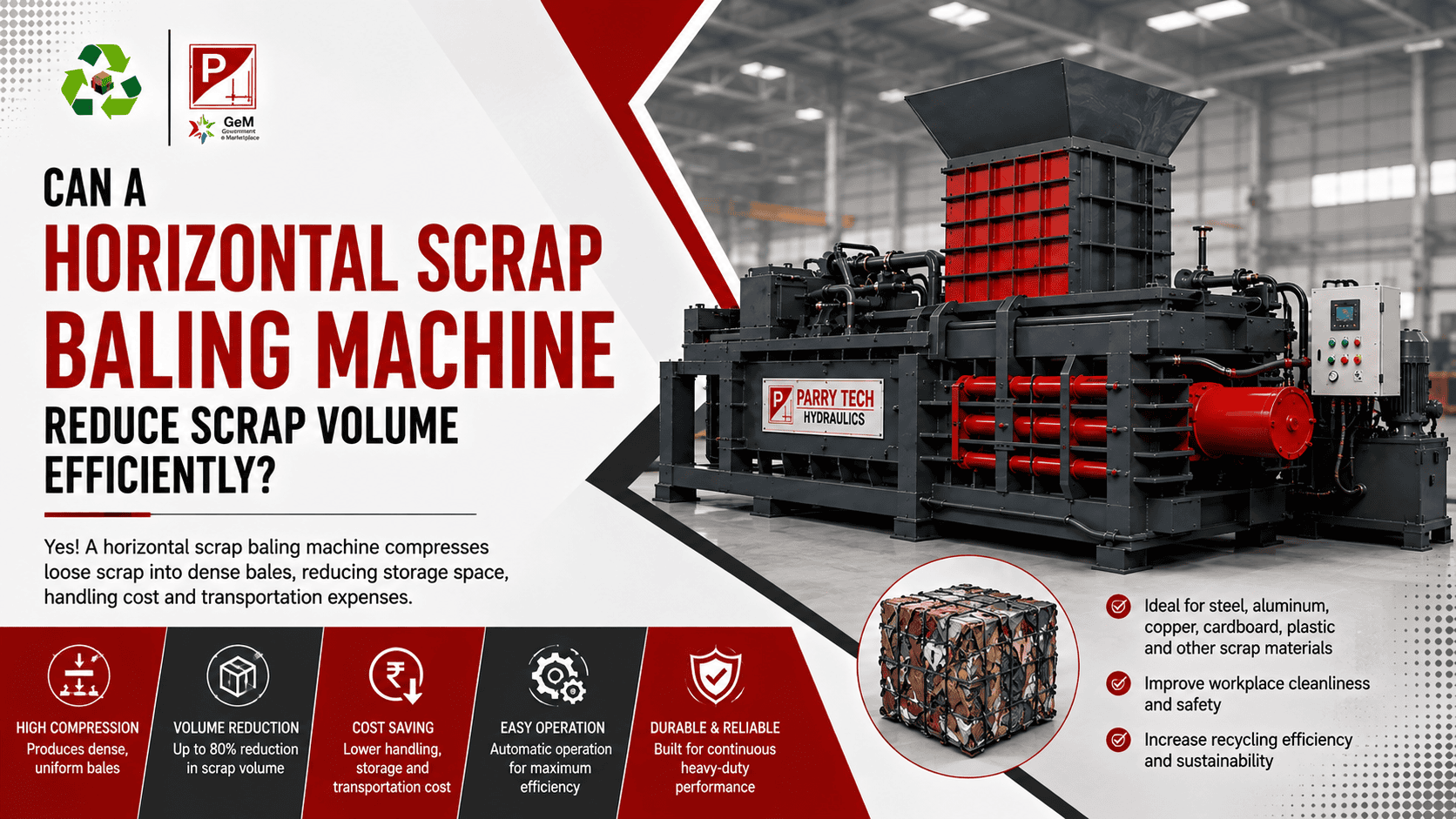
Managing loose scrap is a common challenge for manufacturing units, recycling facilities, fabrication industries, and scrap-processing businesses. Large quantities of loose metal scrap can occupy valuable storage space and make loading, transportation, and handling more difficult. A Horizontal Scrap Baling Machine helps solve this problem by applying high hydraulic pressure to compress loose scrap into compact and manageable bales.
For businesses looking for a Horizontal Scrap Baling Machine in Delhi, the right machine should be selected according to the type of scrap, daily material volume, required bale size, bale weight, available floor space, and desired level of automation. A properly configured hydraulic baler can significantly reduce the space occupied by loose scrap and make the overall material-handling process more organized.
How Does a Horizontal Scrap Baling Machine Reduce Scrap Volume?
A horizontal baling machine works by loading loose scrap into a compression chamber and applying hydraulic force through one or more cylinders. As pressure is applied, the scrap is compressed tightly, reducing the amount of empty space between individual pieces.
Once the required compression is achieved, the material is formed into a compact bale and ejected from the chamber. The finished bale is considerably easier to store, move, stack, and transport compared with loose scrap.
The amount of volume reduction depends on several factors, including the type of scrap, its initial condition, material density, bale dimensions, hydraulic pressure, and machine configuration. Therefore, manufacturers should evaluate the actual scrap rather than expecting the same result from every material.
What Types of Scrap Can Be Baled?
Horizontal hydraulic balers are commonly used for different types of recyclable and industrial scrap, depending on the machine’s design and pressing capacity.
Typical materials may include:
- Mild steel scrap
- Aluminium scrap
- Metal offcuts
- Industrial fabrication scrap
- Sheet-metal waste
- Light metal scrap
- Other recyclable materials
Parrytech Hydraulics manufactures hydraulic baling machines for industrial scrap-processing applications. Its Tripple Action Horizontal Scrap Baling Machine is designed with a large compression chamber and multiple hydraulic cylinders for heavy-duty baling operations.
According to the company’s published specifications, the machine has a 1880 × 962 × 700 mm chamber, 3300 PSI working pressure, a 50 HP motor, and five cylinders. The listed bale size is 15 × 15 × variable. The machine is designed for automatic operation with PLC + HMI control options.
What Makes Horizontal Baling Efficient?
High Hydraulic Compression
Hydraulic force is the main factor responsible for compacting loose material. The required pressure depends on the type and density of scrap.
For heavy metal scrap, sufficient pressing force is necessary to create a compact and stable bale. The machine should therefore be selected according to the actual material and required bale specifications rather than only looking at the machine’s maximum pressure.
Larger Working Chamber
A horizontal baler can accommodate a relatively large quantity of material inside its chamber before each compression cycle. This can be useful for industries generating significant amounts of scrap throughout the working day.
A larger chamber can also help improve workflow when the machine is integrated with regular scrap collection and loading operations.
Multiple Hydraulic Actions
A multi-action hydraulic configuration can provide controlled movements during compression and bale ejection. Parrytech’s Tripple Action Horizontal Scrap Baling Machine uses five cylinders and an ejector-cylinder tilting ejection arrangement.
For industrial users, this type of machine configuration can make the compression and bale-handling process more organized.
Benefits of Reducing Scrap Volume
Saves Storage Space
Loose scrap can occupy a large area because pieces do not stack efficiently. Compact bales can be arranged more systematically, allowing better use of available storage space.
Easier Material Handling
A compact bale is easier to handle than a large quantity of loose pieces. Depending on bale weight and handling equipment, finished bales can be moved using suitable material-handling systems.
More Organized Scrap Storage
Baling can create standardized units that are easier to stack and identify. This can improve general housekeeping around the scrap-storage area.
Better Transportation Efficiency
Loose scrap can contain considerable empty space. Compact bales allow more material to be handled in a more organized form, which can improve the efficiency of loading and transportation.
The exact transportation advantage depends on bale dimensions, vehicle capacity, allowable weight, and the type of scrap being handled.
Important Features to Check Before Buying
Not every horizontal baling machine is suitable for every application. Before purchasing, manufacturers should check several important specifications.
1. Chamber Dimensions
The chamber determines how much material can be loaded during the compression cycle. Compare its dimensions with the size and type of scrap generated at your facility.
2. Hydraulic Pressure
The hydraulic system must generate sufficient force for the material being compressed. Heavy metal scrap generally requires a more robust hydraulic arrangement than lightweight recyclable materials.
3. Bale Size
Bale dimensions affect storage, handling, stacking, and transportation. Discuss the required bale dimensions with the manufacturer before selecting the machine.
4. Bale Weight
Bale weight depends on material density and compression. Parrytech’s published specifications indicate approximate bale weights of 60–120 kg for MS and 40–45 kg for aluminium, depending on operating conditions.
5. Motor Capacity
The hydraulic power unit needs sufficient motor capacity to support the machine’s operating requirements and production cycle.
6. Control System
Automatic operation and PLC/HMI controls can be useful for businesses handling scrap regularly. A suitable control system can help operators manage the machine cycle more consistently.
7. Bale Ejection
The ejection system should be considered because finished bales need to be removed efficiently from the compression chamber.
8. Installation Requirements
A horizontal baler needs adequate space for loading, unloading, bale ejection, operator movement, maintenance, and material handling. Site access and electrical requirements should also be checked before installation.
Is a Horizontal Baler Better Than Handling Loose Scrap?
For operations generating large quantities of scrap, baling can provide significant practical advantages over simply storing loose material.
Loose scrap generally takes up more space and can be difficult to organize. It can also make manual handling and transportation more complicated. Baling converts this loose material into compact units that are easier to store and move.
However, the machine should be selected according to the production environment. A business generating only a small amount of light scrap may not require the same machine configuration as a large metal recycling facility.
Why Choose Parrytech Hydraulics?
Parrytech Hydraulics is a hydraulic machinery manufacturer based in Mundka Industrial Area, New Delhi. The company manufactures hydraulic presses, baling machines, deep-drawing equipment, moulding presses, shearing machines, bending machines, and other industrial hydraulic equipment.
Its hydraulic recycling range includes Automatic Hydraulic Baling Presses, Continuous Baling Machines, Double Action Hydraulic Scrap Baling Presses, Four Side Compression Hydraulic Baling Machines, Horizontal Paper Balers, and Tripple Action Baling Machines.
This range gives customers the opportunity to discuss different machine configurations according to their material, production volume, bale requirements, and available space.
For a customer searching for a Horizontal Scrap Baling Machine in Delhi, working directly with a manufacturer can also make it easier to discuss machine capacity, hydraulic requirements, chamber dimensions, bale specifications, installation, and future maintenance.
Parrytech also provides services including installation and commissioning, machine testing, training, repair and maintenance, upgrades, and breakdown support. These services are important because correct hydraulic settings, installation, and routine maintenance can directly influence machine performance and operating reliability.
How to Select the Right Machine for Your Scrap?
Before purchasing a horizontal scrap baler, provide the manufacturer with practical information about your operation:
- Type of scrap
- Average daily scrap quantity
- Scrap piece size
- Required bale weight
- Required bale dimensions
- Desired production capacity
- Available installation area
- Manual or automatic loading requirements
- Available electrical power
- Bale handling method
This information helps the manufacturer determine the appropriate chamber size, hydraulic capacity, motor, cylinder arrangement, and control system.
Final Thoughts
Yes, a Horizontal Scrap Baling Machine can reduce the volume occupied by loose scrap efficiently by applying controlled hydraulic pressure and converting loose material into compact bales. This can make scrap storage, handling, stacking, and transportation more organized.
The actual reduction in volume depends on the material and machine configuration, so manufacturers should not judge a baler by hydraulic pressure alone. Chamber size, bale dimensions, bale weight, hydraulic system, cylinder arrangement, motor capacity, automation, and ejection system should all be considered.
For businesses searching for a Horizontal Scrap Baling Machine in Delhi, Parrytech Hydraulics offers industrial hydraulic baling solutions that can be configured according to specific scrap-processing requirements. Discussing the scrap type and production conditions with the manufacturer before finalizing the machine can help ensure the selected baler is suitable for the application.
FAQs
1. Can a horizontal baler reduce scrap volume?
Yes. Hydraulic compression significantly reduces the space occupied by loose scrap by converting it into compact bales.
2. What scrap can be compressed?
It can be used for suitable metal and recyclable scrap, depending on the machine’s capacity and configuration.
3. Does a horizontal baler save storage space?
Yes. Compact bales can be stacked more efficiently than loose scrap.
4. Can Parrytech customize a baling machine?
Yes. Machine configuration can be selected according to the scrap type, bale requirements, production volume, and application.
5. Does Parrytech provide installation support?
Yes. Installation, commissioning, testing, training, maintenance, and service support are available.

Leave A Comment