
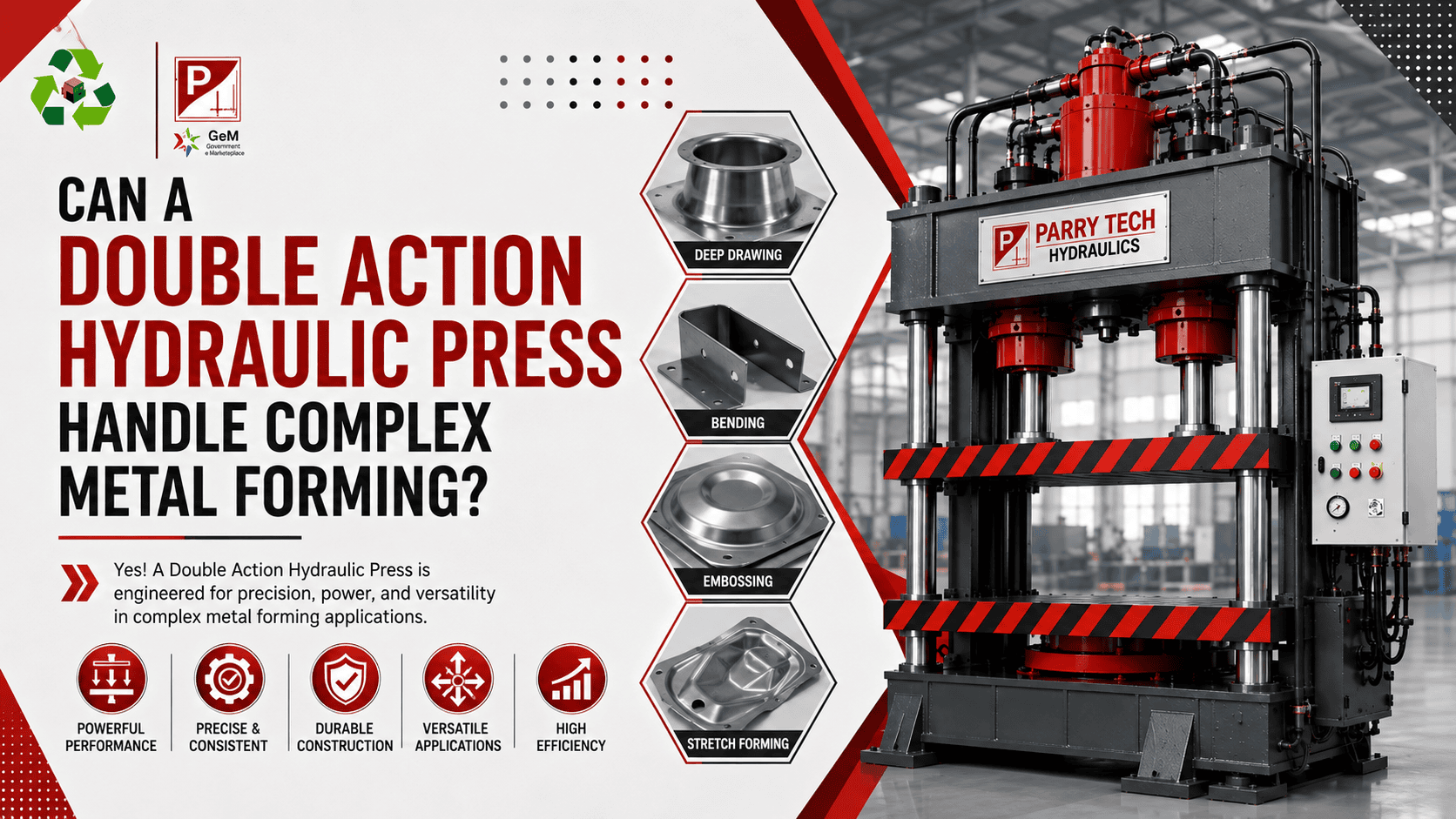
Complex metal forming requires more than simply applying high pressing force. When a component has greater drawing depth, curved profiles, tight dimensions, or difficult material flow, the hydraulic press must provide controlled movement and suitable blank-holder pressure. This is where a Double Action Hydraulic Press becomes particularly useful.
In a double-action press, the main ram and blank holder operate through separate hydraulic actions. This allows the sheet to be held and formed in a controlled sequence, which is important for reducing wrinkles, controlling material flow, and achieving a more consistent finished component. For manufacturers looking for a Double Action Hydraulic Press in Delhi, the machine should be selected according to the material, component geometry, drawing depth, tooling, and required production cycle.
Why Is Complex Metal Forming Difficult?
During deep drawing and other forming operations, the sheet does not simply move downward. Material has to flow from the blank into the die while maintaining the required thickness and shape.
If the material is not properly controlled, several problems can occur:
- Wrinkles around the formed component
- Excessive thinning
- Cracking or tearing
- Uneven component shape
- Inconsistent dimensions
- Higher rejection during production
The correct combination of forming force, blank-holder pressure, stroke, speed, tooling, and material properties is therefore important.
A double-action hydraulic press gives manufacturers greater control over these factors because the blank holder and main ram can perform separate functions during the forming cycle.
How Does Double Action Help With Complex Forming?
The biggest advantage is controlled material movement.
The blank holder applies pressure to the sheet before and during the drawing operation. The main ram then moves the punch into the die to create the required shape. Because the two actions are controlled separately, the manufacturer can manage the sheet more effectively than with a simple pressing arrangement.
For example, when forming a deep component, insufficient blank-holder pressure can allow the material to wrinkle. Excessive pressure, on the other hand, can restrict material flow and increase the possibility of tearing. The correct setting depends on the material, thickness, geometry, and tooling.
This is why machine selection and process setup should be considered together rather than treating press tonnage as the only important specification.
What Types of Components Can It Handle?
Double-action hydraulic presses are commonly used for deep-drawn and formed components such as:
- Stainless-steel kitchen sinks
- Cooking hobs
- Cookers and cookware
- LPG cylinders
- Fire extinguisher bodies
- Automobile components
- Electrical components
- Metal containers
- Other industrial sheet-metal parts
Parrytech Hydraulics specifically lists applications including S.S. sinks, LPG cylinders, geysers, AC components, cooking hobs, and automobile components for its hydraulic deep-draw press with blank holder.
The company also manufactures dedicated deep-drawing equipment for cooker manufacturing and other steel and automobile component applications.
Important Machine Features for Complex Forming
1. Independent Blank Holder
The blank holder is one of the most important features when forming complicated sheet-metal components. It controls the material while the main ram performs the drawing operation.
Parrytech’s double-action press range includes models with dedicated blank-holder capacities and strokes. Its published configurations range from 100-ton to 1000-ton total capacity, with different blank-holder capacities, stroke lengths, daylight, and bed sizes.
2. Suitable Stroke Length
Complex components may require a longer drawing stroke. If the stroke is insufficient, the required component depth cannot be achieved in a single operation.
Parrytech’s listed double-action models have stroke lengths ranging from 475 mm to 1100 mm, depending on machine capacity.
3. Adequate Daylight
Daylight is the available space between the press components when the ram is in its relevant position. It must be sufficient for the die, punch, workpiece, and required tooling arrangement.
For complex forming, manufacturers should confirm the complete die height and working clearance before selecting the machine.
4. Appropriate Bed Size
The die must fit securely on the press bed. As component dimensions increase, the required platen size also increases.
Parrytech’s published double-action configurations include bed sizes from 400 × 400 mm up to 2200 × 2200 mm, depending on capacity.
5. Hydraulic Control
Stable hydraulic pressure is important for repeatable forming. Parrytech’s double-action deep-draw press is listed with PLC control, Yuken/Rexroth solenoid valves, Polyhydron pre-fill valves, and ABB/Havells motors.
The actual hydraulic settings still need to be established according to the material and tooling. A well-designed machine provides the control capability; proper process setup determines how that capability is used.
Can It Handle Deep Drawing?
Yes. Deep drawing is one of the primary applications for double-action hydraulic presses.
Parrytech’s product range includes hydraulic deep-drawing presses with blank holders and die cushions. Its deep-draw equipment is designed for applications requiring controlled forming, consistent pressure, and precision.
For particularly demanding components, a die-cushion arrangement may also be appropriate. The correct solution depends on the component geometry, material, required drawing depth, and tooling design.
How Do Manufacturers Select the Correct Tonnage?
Tonnage should be calculated according to the actual forming requirement rather than selecting the largest available press.
Manufacturers generally need to consider:
- Material type
- Sheet thickness
- Blank diameter
- Final component dimensions
- Drawing depth
- Number of drawing operations
- Die and punch geometry
- Required blank-holder force
- Production cycle
For example, Parrytech’s standard double-action range includes 100, 150, 200, 250, 300, 400, 500, 600, 800, and 1000-ton configurations, while the company states that higher-capacity presses up to 4000 tons can be manufactured for heavy-duty applications.
This range allows the machine to be matched more closely to the application instead of forcing every manufacturer into the same press configuration.
Why Choose Parrytech Hydraulics for Complex Metal Forming?
Parrytech Hydraulics operates from Mundka Industrial Area, New Delhi, and specializes in hydraulic presses, deep-drawing presses, rubber moulding presses, transfer moulding equipment, and other industrial hydraulic machinery.
The company’s deep-drawing range demonstrates practical attention to different forming requirements. Its machines are offered with different capacities, blank-holder arrangements, stroke lengths, bed sizes, and hydraulic configurations. The company also states that presses can be manufactured according to customer requirements.
For a manufacturer dealing with a complicated component, this customization is important. The machine should be discussed alongside the actual component drawing, material specification, tooling arrangement, production quantity, and required cycle.
Parrytech also lists installation and commissioning, machine testing, training, repair and maintenance, upgrades, and breakdown support among its services.
For customers searching for a Double Action Hydraulic Press in Delhi, having the manufacturer based in Mundka Industrial Area can also make technical discussions, machine inspection, installation coordination, and service support more convenient. Parrytech Hydraulics
Final Thought
Yes, a Double Action Hydraulic Press can handle many complex metal-forming applications, particularly deep drawing and components where controlled material flow is important. However, the press must be correctly matched with the component, material, die, drawing depth, required force, blank-holder pressure, stroke, and production requirements.
The important point is that higher tonnage alone does not guarantee better forming. The hydraulic system, blank-holder control, machine rigidity, tooling, and process settings all work together to determine the final result.
For manufacturers looking for a Double Action Hydraulic Press in Delhi, Parrytech Hydraulics offers multiple configurations and customized hydraulic press solutions for different deep-drawing and metal-forming requirements.
FAQs
1. Can a double-action press form complex components?
Yes. Its separate ram and blank-holder actions provide better control for demanding forming and deep-drawing operations.
2. Is it suitable for deep drawing?
Yes. Double-action presses are widely used for deep-drawing applications such as sinks, cookware, hobs, and industrial components.
3. How do I select the correct tonnage?
Tonnage depends on material, thickness, component dimensions, drawing depth, tooling, and required forming force.
4. Can Parrytech customize the press?
Yes. Parrytech states that its presses can be manufactured according to customer requirements.
5. Does Parrytech provide installation support?
Yes. The company provides installation, commissioning, testing, training, maintenance, and service support.

Leave A Comment