
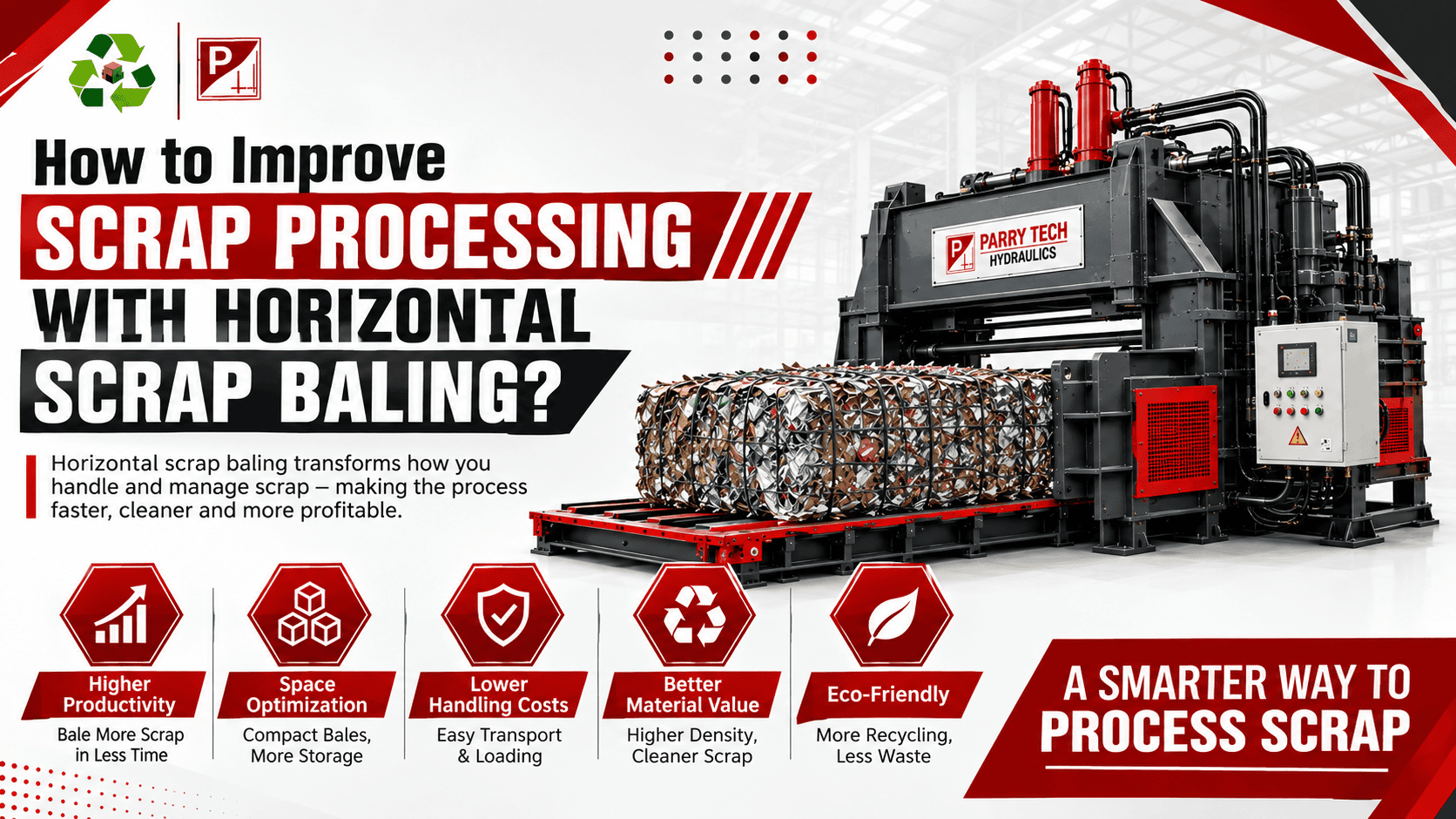
Scrap processing becomes inefficient when loose material keeps moving between the production floor, collection area, storage yard and transport section. Metal offcuts, aluminium pieces, fabrication waste and other recyclable scrap can quickly create handling problems when there is no systematic way to collect and compact them.
Horizontal scrap baling provides a practical way to bring these activities together. Instead of handling loose scrap repeatedly, a hydraulic baling machine compresses suitable material into compact bales that can be moved, stacked and transported more easily. For an industrial unit considering a Horizontal Scrap Baling Machine in Delhi, the real benefit comes from integrating the baler properly into the existing scrap-handling process.
Start With the Scrap, Not the Machine
One of the most common mistakes when selecting a baler is starting with machine capacity instead of understanding the scrap.
Before deciding on a machine, look at the material being generated. Is it mild steel, aluminium, sheet-metal offcut, fabrication scrap or a mixture? Are the pieces long and thin, bulky, sharp or irregular? How much material is generated per shift?
These details influence the required chamber size, hydraulic force, bale dimensions and operating method.
A machine that works well for aluminium may not produce the same bale characteristics with dense MS scrap. Parrytech Hydraulics’ published Tripple Action Horizontal Scrap Baling Machine, for example, lists approximate bale weights of 60–120 kg for MS and 40–45 kg for aluminium, showing how strongly material type affects the finished bale.
Build a Better Collection Process
A baler works best when scrap reaches it in a controlled flow.
Instead of allowing waste to accumulate randomly around different machines, companies can create defined collection points. Scrap can then be shifted to the baling area at regular intervals.
This approach offers two practical advantages. Production areas remain more organized, and the baler receives material in a predictable manner rather than being overloaded suddenly with mixed scrap.
For larger facilities, the collection system can be planned around forklifts, bins, conveyors or other material-handling equipment according to the plant layout.
Use the Baler to Reduce Repeated Handling
Every additional movement of loose scrap consumes labour and time. Scrap may be collected, shifted, piled, rearranged and then loaded again for transportation.
Baling reduces some of this repeated handling because loose material becomes a compact unit after compression.
Once the bale is ready, it can be moved with suitable lifting equipment and placed directly into the designated storage or dispatch area. This makes the overall scrap workflow easier to organize.
The objective is not simply to produce a bale; it is to reduce unnecessary movement throughout the factory.
Match Bale Size With Your Handling System
The bale should be designed around what happens after compression.
If the finished bale is too heavy for the available lifting equipment, handling can become difficult. If it is too small, the company may not obtain the expected improvement in storage efficiency.
Parrytech’s published Tripple Action machine produces a listed bale size of 15 × 15 × variable. Its chamber is specified as 1880 × 962 × 700 mm, with a five-cylinder hydraulic arrangement.
These specifications show why bale dimensions should be finalized together with the storage and handling system rather than selected independently.
Improve Processing Through Consistent Operating Cycles
In a busy scrap-processing environment, consistency matters.
A machine that follows a repeatable compression sequence can make operation easier for workers and reduce variation between production cycles. Automatic hydraulic operation can be especially useful where scrap is generated throughout the day.
Parrytech’s published horizontal scrap baler is listed with automatic operation and PLC + HMI control options, along with pressure-transmitter/conductor-based control and an optional pressure switch arrangement.
For manufacturers, the advantage is not simply automation itself. The important point is having a controlled operating sequence that fits the way scrap is loaded and removed from the machine.
Keep Different Scrap Types Organized
Mixed scrap can create problems during baling because materials have different densities and compression characteristics.
For example, steel and aluminium should not automatically be treated as identical simply because both are recyclable metals. If the downstream recycling process requires material separation, keeping them separate before baling can make further processing easier.
A practical system can therefore include separate collection for different materials, followed by dedicated or scheduled baling.
This can also make inventory and dispatch easier because the finished bales are already categorized by material.
Reduce Storage Problems With Better Bale Placement
A baling machine can improve space utilization, but the storage area still needs to be planned.
Finished bales should have clearly defined locations based on:
- Material type
- Bale weight
- Dispatch schedule
- Handling equipment
- Maximum safe stacking arrangement
The goal is to ensure that the gain achieved through compression is not lost because finished bales are simply placed randomly around the yard.
A well-planned storage layout can make forklift movement, loading and dispatch more efficient.
Choose Hydraulic Specifications According to the Job
Hydraulic pressure is important, but it is only one part of the machine.
Parrytech’s published Tripple Action Horizontal Scrap Baling Machine specifies a 3300 PSI working pressure, 50 HP motor, 1000-litre oil tank, and five cylinders. The machine is approximately 11.5 tonnes in weight and has overall dimensions of around 19 × 9.6 × 7.6 ft.
When evaluating equipment, manufacturers should therefore consider the complete combination of chamber dimensions, motor capacity, cylinder arrangement, pressure, bale size and installation requirements.
The right machine is the one that fits the application’s production cycle rather than simply having the highest specification.
Plan Installation Before Delivery
A horizontal baler requires more than a suitable floor area.
The installation plan should consider machine entry, foundation or floor requirements, electrical supply, scrap-feeding arrangements, bale removal, operator access and space for maintenance.
Parrytech Hydraulics states that it provides installation and commissioning, including machine setup, testing and training. It also offers repair, maintenance, upgrades and breakdown support.
This is particularly important for heavy hydraulic equipment because installation and commissioning are part of making the machine ready for regular production.
Maintenance Is Part of Scrap-Processing Efficiency
A baler can only improve productivity if it remains available for production.
Routine checks of hydraulic oil, filters, cylinders, hoses, valves, electrical controls and moving components can help identify problems before they interrupt operations.
Maintenance should also be scheduled around actual operating conditions. A machine processing heavy metal scrap at high utilization may need closer attention than equipment working only occasionally.
Parrytech specifically lists repair and maintenance, upgrades and breakdown support as part of its services.
Why Parrytech Hydraulics?
Parrytech Hydraulics manufactures hydraulic and recycling equipment from Mundka Industrial Area, New Delhi. Its product range includes multiple baling configurations along with hydraulic presses, deep-draw presses, moulding machinery and other industrial hydraulic systems.
Its baling range includes Four Side Compression Hydraulic Baling Machine, Automatic Hydraulic Baling Press, Double Action Hydraulic Scrap Baling Press, Continuous Baling Machine, Horizontal Paper Baler and Tripple Action Baling Machine.
This broader manufacturing background is useful when the customer needs a machine matched to a particular scrap-handling problem rather than a generic baler.
Parrytech also highlights customized hydraulic system design and application-specific solutions. For a manufacturer evaluating a Horizontal Scrap Baling Machine in Delhi, discussing material type, scrap volume, bale requirements, available space and handling arrangements directly with the machine manufacturer can lead to a more suitable configuration.
A Practical Improvement Strategy
A successful scrap-baling setup can be viewed as one complete process:
Scrap generation → segregation → collection → feeding → hydraulic compression → bale ejection → storage → dispatch
Improvement becomes easier when each stage supports the next.
If scrap arrives mixed and oversized, the baler may not perform efficiently. If the bale cannot be handled after ejection, storage becomes the next bottleneck. If maintenance is neglected, machine downtime can interrupt the entire scrap workflow.
The machine is therefore only one part of the solution. Good process planning is what turns a baler into an efficient scrap-management system.
Final Thoughts
Horizontal scrap baling can improve scrap processing by reducing repeated handling, improving storage organization, creating manageable bales and making material movement more systematic.
The best results come when the machine is selected according to the actual scrap, bale requirements and production environment. Chamber size, hydraulic pressure, motor, cylinders, automation, ejection system, installation space and maintenance support should all be considered together.
For companies searching for a Horizontal Scrap Baling Machine in Delhi, Parrytech Hydraulics offers different hydraulic baling configurations and customized industrial solutions. A discussion based on actual scrap material, daily quantity, bale requirements and factory layout is a more reliable starting point than selecting a machine on capacity alone.
FAQs
1. How does horizontal baling improve scrap processing?
It converts loose scrap into compact bales, reducing repeated handling and making storage and transportation easier.
2. Which factors affect machine selection?
Scrap type, daily quantity, piece size, bale weight, chamber size, hydraulic capacity and available space are important.
3. Can different scrap materials be processed?
Yes, but the machine configuration and operating conditions should suit the specific material.
4. Is automatic operation available?
Yes. Parrytech’s Tripple Action Horizontal Scrap Baling Machine is listed with automatic operation and PLC + HMI control options.
5. Does Parrytech provide installation and maintenance?
Yes. The company lists installation, commissioning, testing, training, repair, maintenance, upgrades and breakdown support among its services.

Leave A Comment