
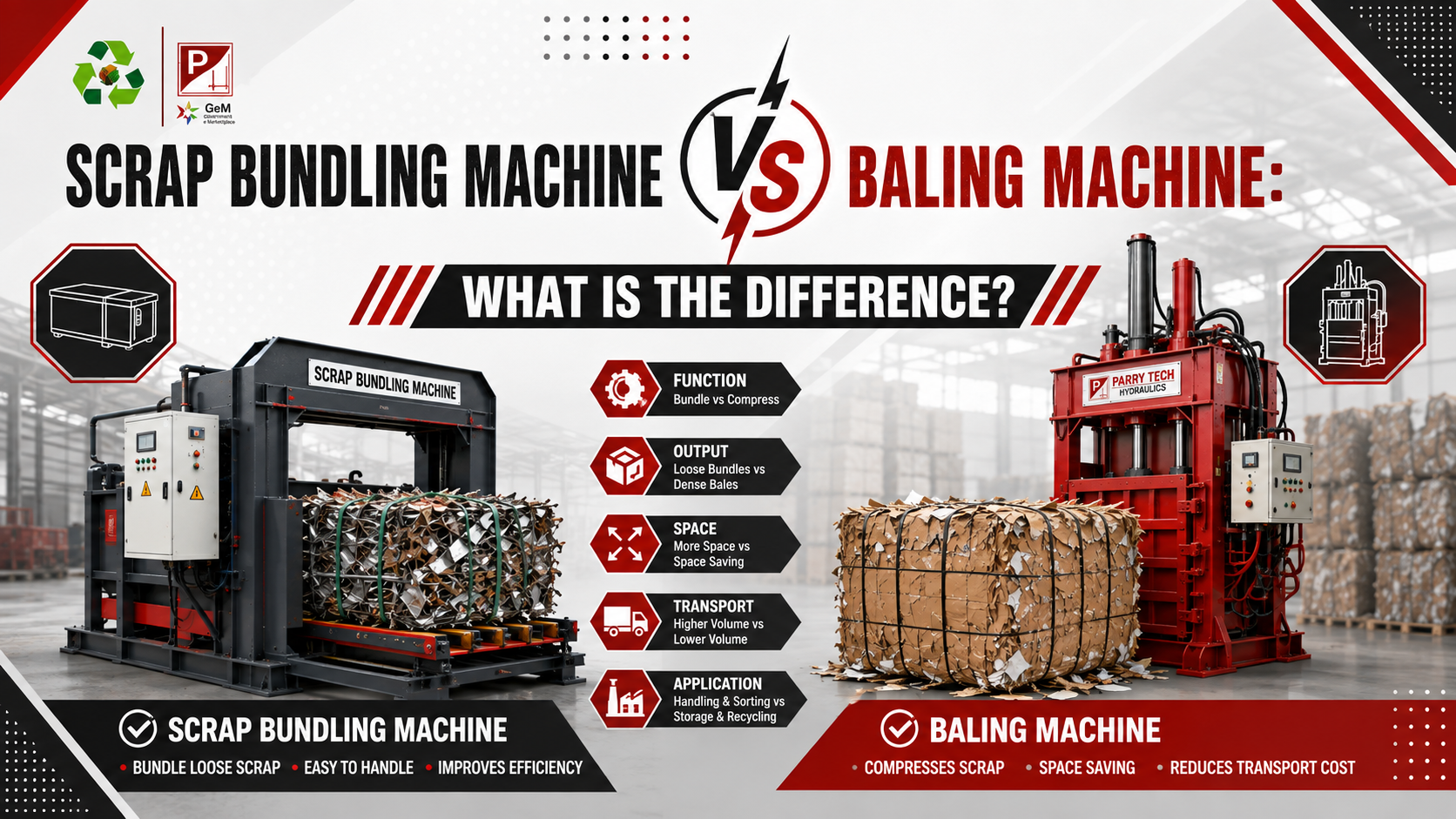
Scrap management becomes difficult when loose metal pieces, wire, sheets, production offcuts, or recyclable waste start occupying valuable factory space. Two machines commonly considered for improving scrap handling are a Scrap Bundling Machine and a Baling Machine. Although both are used to make scrap easier to handle, they are not necessarily designed for the same type of material or the same final result.
The main difference is in the way the material is prepared and held together. Bundling generally focuses on tying or grouping relatively long, loose, or similar pieces into manageable bundles, while baling uses compression to form compact bales. Choosing between them depends on the material, its shape, required density, production volume, and how the finished material will be stored or transported.
For manufacturers searching for a Scrap Bundling Machine in Delhi, understanding this difference before purchasing can help avoid selecting equipment that does not match the actual scrap-handling process.
What Is a Scrap Bundling Machine?
A scrap bundling machine is generally used to gather and secure similar scrap pieces into a compact bundle. It can be useful for long, narrow, or relatively uniform material where tying or grouping is more practical than compressing everything into a dense block.
Depending on the machine and application, bundling can be useful for suitable metal strips, wires, long offcuts, and other materials that are easier to handle when grouped together.
The purpose is mainly to make loose material easier to collect, move, store, and transport. The final bundle may retain more of the original shape of the material than a highly compressed bale.
The machine configuration should always be selected according to the actual scrap shape and handling requirement because different types of scrap behave very differently during bundling.
What Is a Scrap Baling Machine?
A baling machine uses hydraulic or mechanical compression to reduce the volume of suitable scrap and form it into a compact bale. The material is placed inside a compression chamber, pressure is applied, and the finished bale is then ejected for handling or storage.
Hydraulic balers are particularly useful where the objective is to reduce loose scrap volume and produce standardized, compact units.
Parrytech Hydraulics manufactures several types of hydraulic baling equipment, including Automatic Hydraulic Baling Presses, Double Action Hydraulic Scrap Baling Presses, Four Side Compression Hydraulic Baling Machines, Continuous Baling Machines, Horizontal Paper Balers, and Tripple Action Baling Machines.
Its Tripple Action Horizontal Scrap Baling Machine, for example, has a 1880 × 962 × 700 mm chamber, five cylinders, automatic operation, PLC + HMI control options, a 50 HP motor, and 3300 PSI working pressure.
Scrap Bundling vs Baling: The Main Difference
The easiest way to understand the difference is to look at the final form of the material.
Bundling:
Loose or long pieces are grouped and secured together to form a manageable bundle.
Baling:
Loose scrap is compressed under pressure to produce a denser and more compact bale.
This means bundling is often more appropriate when the scrap naturally has a long or similar shape, while baling is generally more suitable when volume reduction and compact storage are the main priorities.
1. Difference in Material Type
The material itself should be the starting point when deciding between bundling and baling.
A bundling system can be useful for long, narrow, or similar pieces that can be grouped together without requiring extreme compression.
A baling machine is more suitable when the scrap is loose, irregular, and needs to be compacted under hydraulic pressure. Metal offcuts, suitable aluminium scrap, sheet-metal waste, and industrial recyclable scrap can be baled when the machine is correctly configured for the material.
Before choosing the machine, manufacturers should consider the material’s thickness, length, shape, density, and contamination level.
2. Difference in Volume Reduction
If the main objective is reducing scrap volume, a hydraulic baling machine is usually the more appropriate solution because the material is physically compressed.
Loose scrap contains a lot of empty space between individual pieces. Hydraulic pressure reduces these gaps and creates a compact bale.
Bundling does improve handling and organization, but it does not necessarily achieve the same level of volume reduction as compression baling.
This distinction is particularly important for factories where scrap storage space is limited or where transportation efficiency is a major concern.
3. Difference in Bale or Bundle Density
Baling is specifically intended to create compact material units. The final density depends on the material, hydraulic pressure, chamber design, loading method, and machine settings.
A bundle, on the other hand, may retain more of the original geometry of the scrap. For certain long pieces, this is actually an advantage because the material can remain easier to identify, sort, or process later.
Therefore, the question is not which machine is universally better. The question is whether your operation needs compression or primarily grouping and securing.
4. Storage Requirements
Storage conditions can strongly influence the machine choice.
If scrap is difficult to stack because pieces are loose and irregular, bundling may improve organization.
When the objective is to maximize storage density, baling generally offers a stronger advantage because compressed bales can be stacked and handled as standardized units.
For larger recycling and manufacturing facilities, this can make a noticeable difference in scrap-yard organization.
5. Transportation and Handling
Handling loose scrap can require considerable manual effort or repeated loading operations.
Bundles and bales are both easier to handle than loose material, but the appropriate choice depends on the material and the handling equipment available at the facility.
Bales can be particularly practical where forklifts, cranes, or other lifting arrangements are already part of the scrap-handling process.
6. Production Volume
Daily scrap generation also matters.
A small fabrication unit producing limited quantities of relatively uniform scrap may have a straightforward bundling requirement.
A recycling plant or large manufacturing operation producing high volumes of mixed or loose scrap may benefit more from hydraulic baling, particularly where automated operation is required.
Parrytech’s hydraulic baling range includes automatic systems designed for industrial applications, giving manufacturers different configurations depending on their material and production requirements.
When Should You Choose a Scrap Bundling Machine?
A bundling machine may be considered when:
- Scrap pieces are long and relatively uniform.
- The material needs to remain identifiable.
- Grouping is more important than maximum compression.
- The finished material needs to stay in a manageable bundle.
- The handling process is based around tied or grouped material.
- Storage organization is the primary objective.
The exact machine arrangement should still be selected according to the material and desired bundle dimensions.
When Should You Choose a Baling Machine?
A baling machine may be the better choice when:
- Scrap is loose and irregular.
- Significant volume reduction is required.
- Storage space is limited.
- Compact bales are easier to transport.
- Scrap is generated in large quantities.
- Standardized bale dimensions are required.
- Hydraulic compression is needed.
- Automatic production is preferred.
For heavy industrial scrap, a suitable hydraulic baling machine can provide a more organized and space-efficient solution.
Important Features to Check Before Buying a Baling Machine
If you decide that baling is more suitable, several specifications should be evaluated.
Compression Chamber
The chamber should accommodate the size and quantity of scrap generated during each cycle.
Parrytech’s published Tripple Action Horizontal Scrap Baling Machine uses a chamber measuring 1880 × 962 × 700 mm.
Hydraulic Pressure
The hydraulic system should provide enough force for the material being processed. Parrytech lists 3300 PSI working pressure for this machine.
Bale Dimensions and Weight
The desired bale size affects storage, handling, and transportation. Parrytech lists a bale size of 15 × 15 × variable and approximate bale weights of 60–120 kg for MS and 40–45 kg for aluminium for its published configuration.
Automation
For regular industrial operation, automation can reduce repetitive manual intervention. The Parrytech machine is listed with automatic operation and PLC + HMI control options.
Ejection Arrangement
The finished bale must be removed efficiently after compression. The published Parrytech configuration includes an ejector-cylinder tilting ejection system.
Why Choose Parrytech Hydraulics?
Parrytech Hydraulics is based in Mundka Industrial Area, New Delhi, and manufactures hydraulic machinery and recycling balers. The company describes its approach as application-focused, with experienced engineers working on customized hydraulic solutions. It also provides installation and commissioning, repair and maintenance, upgrades, and breakdown support.
Its product range covers several types of hydraulic and recycling equipment rather than a single baling configuration. This includes automatic balers, double-action scrap balers, four-side compression machines, continuous balers, horizontal paper balers, and triple-action baling machines.
For a customer looking for a Scrap Bundling Machine in Delhi, this broader hydraulic and recycling machinery experience is useful because the correct equipment depends heavily on the shape, quantity, and handling requirements of the scrap.
The company also provides on-site machine setup, testing, and training, while its maintenance services cover repair, upgrades, and breakdown support.
How to Choose Between Bundling and Baling?
Before buying, manufacturers should answer a few practical questions:
What type of scrap do we generate?
Long strips, wires, and similar pieces may suit bundling, while loose and irregular scrap may be more suitable for compression baling.
Do we need grouping or volume reduction?
If grouping is the priority, bundling may be sufficient. If compactness is the main objective, baling is generally more appropriate.
What quantity is generated every day?
Higher scrap volumes often justify hydraulic and automatic baling systems.
How will the finished material be handled?
The choice should match your forklift, crane, storage, and transportation arrangements.
What final size is required?
Bundle dimensions and bale dimensions should be discussed with the manufacturer before selecting the machine.
Final Thoughts
A Scrap Bundling Machine and a Baling Machine both make scrap handling easier, but they solve slightly different problems.
A bundling machine is generally intended to group suitable long or similar scrap pieces into manageable bundles. A baling machine uses compression to turn loose scrap into compact bales, making it more suitable when volume reduction, dense storage, and efficient transportation are the main goals.
The right choice depends on the scrap material, shape, daily volume, storage space, handling method, and required final form.
For businesses looking for a Scrap Bundling Machine in Delhi, it is important to first determine whether the operation actually requires bundling or whether hydraulic compression baling would provide greater practical benefits. Discussing the actual scrap with an experienced manufacturer can help identify the more suitable machine configuration.
FAQs
1. What is the main difference between bundling and baling?
Bundling groups and secures scrap, while baling compresses loose material into compact bales.
2. Which is better for volume reduction?
A hydraulic baling machine is generally more suitable when significant scrap-volume reduction is required.
3. Can metal scrap be bundled?
Yes, suitable long or similarly shaped metal scrap can be grouped into bundles depending on the machine design.
4. Is baling better for loose industrial scrap?
In many industrial applications, yes, especially when compact storage and easier transportation are important.
5. Can Parrytech help select the right machine?
Yes. Parrytech provides application-focused hydraulic and recycling equipment and offers customized hydraulic solutions according to customer requirements.

Leave A Comment