
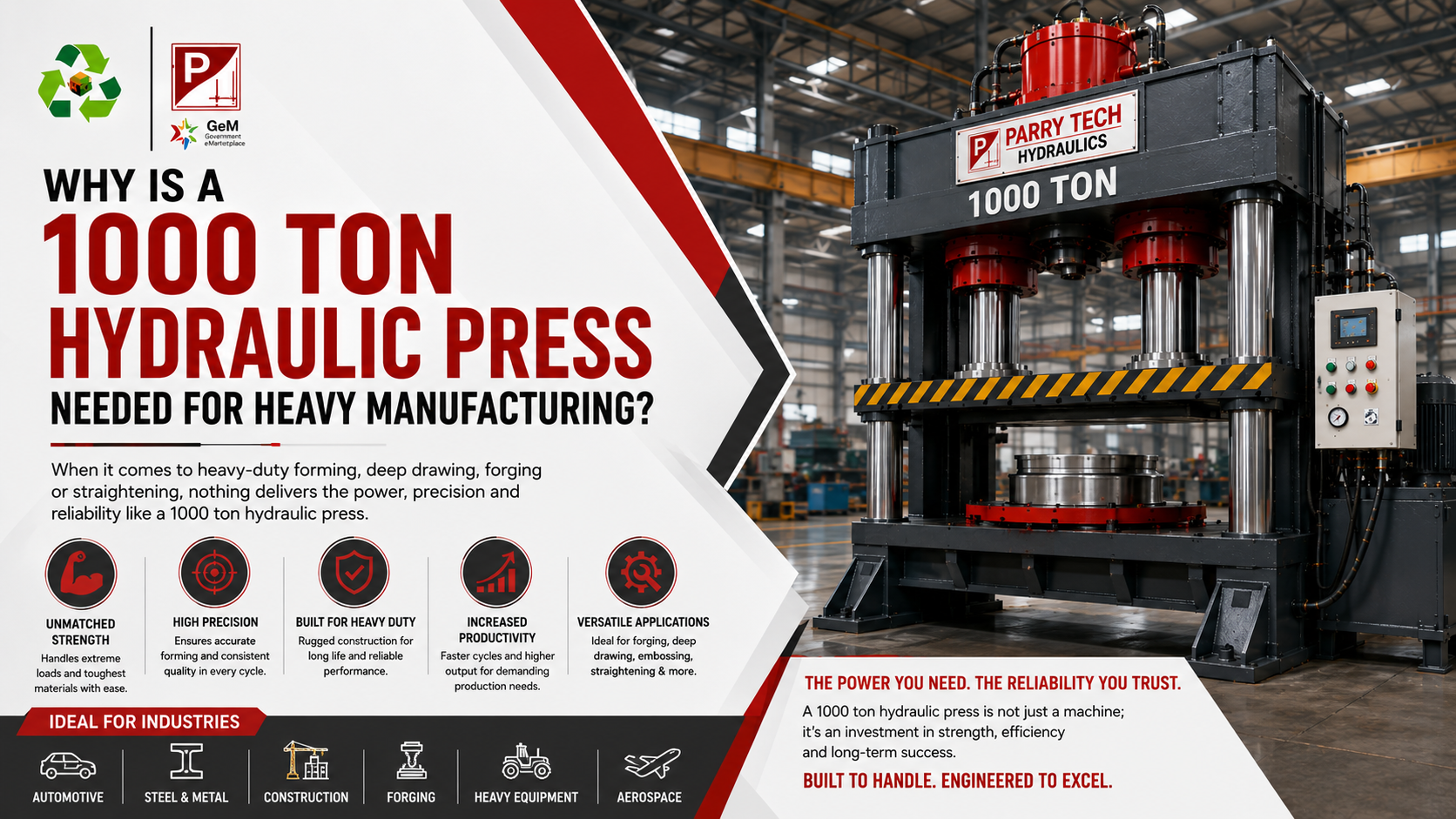
Heavy manufacturing often involves large components, thick materials, high forming forces, and demanding production cycles. In such applications, a standard hydraulic press may not provide enough force or working capacity. A 1000 Ton Hydraulic Press is designed for operations where substantial controlled hydraulic force is required for metal forming, deep drawing, moulding, pressing, and other heavy-duty industrial processes.
However, choosing a 1000-ton press should not be based on tonnage alone. Manufacturers also need to evaluate the material, component dimensions, die size, stroke, daylight, production cycle, hydraulic system, and required automation. For businesses looking for a 1000 Ton Hydraulic Press in Delhi, understanding these factors is important before selecting the machine.
What Makes a 1000 Ton Hydraulic Press Different?
A 1000-ton hydraulic press is capable of delivering very high pressing force through its hydraulic cylinders. The hydraulic power unit generates pressure and transfers it to the cylinders, which move the ram and apply force to the workpiece.
This high capacity makes the machine suitable for large or difficult forming operations where lower-tonnage presses may not have sufficient force. The actual machine configuration, however, depends on the application.
For example, Parrytech Hydraulics offers a 1000-ton hydraulic deep-draw press configuration with a 500 + 500 ton arrangement, 2200 × 2200 mm bed, 1200 mm platen size, 1100 mm daylight, 500 mm main-cylinder stroke, and 600-ton blank-holder capacity. This shows why manufacturers should examine the complete specification rather than considering tonnage alone.
Why Is 1000 Tons Needed in Heavy Manufacturing?
1. High Force for Large Components
Large or thick components can require substantial forming force. A 1000-ton press provides the capacity needed for demanding pressing and forming operations where smaller machines may not be suitable.
The required force depends on material strength, thickness, component geometry, tooling, and the specific process. Therefore, the press should be sized from actual production requirements rather than choosing a high-tonnage machine without calculation.
2. Suitable for Deep Drawing
Deep drawing requires controlled movement of metal into a die while maintaining the required component shape. When the component is large or requires considerable forming force, a high-capacity press becomes useful.
A suitable blank holder or die cushion can help control material flow during the drawing cycle. Parrytech’s high-capacity deep-draw configurations demonstrate the use of blank-holder and die-cushion arrangements for demanding forming applications.
The correct combination of main pressing force and auxiliary forming capacity is important because excessive or insufficient material control can affect the finished component.
3. Supports Heavy-Duty Forming
A 1000-ton press can be used for heavy metal forming, industrial components, large sheet-metal parts, moulding applications, and other production operations that require considerable hydraulic force.
Depending on tooling and machine construction, applications may include:
- Heavy sheet-metal forming
- Deep-drawn components
- Automobile parts
- Steel utensil manufacturing
- Rubber moulding
- Composite moulding
- Industrial pressing
- Large formed components
The actual application determines which press configuration is appropriate.
Important Features to Check Before Buying
A high tonnage does not automatically mean a machine is suitable for your production. Manufacturers should evaluate the complete hydraulic press configuration.
Press Capacity
The machine must provide sufficient force for the actual forming or pressing operation. It is also important to understand whether the stated tonnage refers to the main cylinder, combined cylinders, or another configuration.
Bed and Platen Size
Large dies require adequate working area. A press can have sufficient tonnage but still be unsuitable if its bed is too small for the required tooling.
Stroke Length
Stroke determines the ram’s available travel. Deep-drawing and forming operations may require substantial stroke depending on the component depth and tooling arrangement.
Daylight
The distance available for tooling must be sufficient to accommodate the die, punch, workpiece, and required working clearance.
Blank Holder or Die Cushion
When deep drawing is involved, material flow needs to be controlled. A suitable blank-holder or die-cushion arrangement can be essential for achieving consistent forming results.
Hydraulic System
The pump, cylinders, valves, filtration, oil tank, pressure controls, and cooling system should be appropriate for the machine’s working cycle.
Control System
PLC and HMI-based controls can help manage repeated pressing sequences and monitor operating parameters in production environments.
How Does a 1000 Ton Press Improve Production?
A high-capacity hydraulic press can help manufacturers process larger components without dividing the operation into unnecessary stages. Depending on the component and tooling, this may improve production workflow and reduce the need for multiple smaller pressing operations.
Controlled hydraulic movement also allows the forming cycle to be adjusted according to the application. Pressure, stroke, and operating sequence can be managed to suit the material and tooling.
For demanding production, consistency is particularly important. Correct machine setup, die alignment, hydraulic pressure, lubrication, material quality, and preventive maintenance all contribute to reliable results.
Why Choose Parrytech Hydraulics?
Parrytech Hydraulics manufactures hydraulic machinery from Mundka Industrial Area, New Delhi. Its product range includes hydraulic presses, deep-drawing presses, rubber moulding presses, transfer moulding machines, baling machines, shearing machines, bending machines, and other industrial hydraulic equipment.
The company provides application-focused hydraulic machinery rather than treating every production requirement in the same way. For high-capacity presses, factors such as component dimensions, material, tooling, stroke, bed size, blank-holder requirements, and production cycle can be considered during machine configuration.
Parrytech’s published hydraulic press configurations include high-capacity deep-drawing machines with different platen sizes, daylight, stroke lengths, and auxiliary forming arrangements. The company also states that heavy-duty presses can be manufactured according to customer requirements.
For manufacturers searching for a 1000 Ton Hydraulic Press in Delhi, working with a local manufacturer can make technical discussions, machine inspection, installation planning, commissioning, and service coordination more convenient.
Parrytech also provides services such as installation and commissioning, machine testing, training, repair and maintenance, upgrades, and breakdown support. For a heavy-duty hydraulic press, these services are important because installation, alignment, hydraulic settings, and regular maintenance can directly affect machine performance.
Who Should Consider a 1000 Ton Hydraulic Press?
A 1000-ton press can be considered by manufacturers that:
- Produce large or heavy components
- Require high forming force
- Perform deep drawing
- Work with thick or high-strength materials
- Need large tooling capacity
- Require controlled hydraulic pressing
- Have high production requirements
- Need a customized heavy-duty pressing solution
It may not be necessary for smaller components or low-force applications. Selecting a machine with considerably higher capacity than the actual requirement can make the installation and operating system unnecessarily large.
What Information Should You Give the Manufacturer?
Before selecting a 1000-ton hydraulic press, manufacturers should provide:
- Material type and thickness
- Component dimensions or drawing
- Required forming depth
- Die dimensions
- Required pressing force
- Desired stroke
- Production quantity
- Required cycle time
- Blank-holder or die-cushion requirements
- Automation requirements
- Available installation space
This information allows the manufacturer to determine whether a 1000-ton configuration is appropriate and what additional hydraulic or mechanical features are required.
Final Thought
A 1000 Ton Hydraulic Press is needed when heavy manufacturing processes demand substantial forming force, large working dimensions, controlled hydraulic movement, and reliable performance under demanding production conditions.
Its advantages become especially valuable in deep drawing, heavy metal forming, large component pressing, and specialized moulding applications. However, the 1000-ton rating is only one part of the machine. Bed size, stroke, daylight, hydraulic system, blank-holder capacity, tooling, and control system must all match the production requirement.
For companies looking for a 1000 Ton Hydraulic Press in Delhi, Parrytech Hydraulics offers high-capacity hydraulic press solutions and application-based machine configurations. Discussing the component, material, tooling, and production process with the manufacturer is the best way to determine the right configuration.
FAQs
1. What is a 1000 Ton Hydraulic Press used for?
It is used for heavy pressing, metal forming, deep drawing, moulding, and large industrial components.
2. Is 1000 tons suitable for deep drawing?
Yes, when the machine has suitable stroke, tooling, blank-holder or die-cushion capacity, and hydraulic control.
3. Can Parrytech manufacture a 1000-ton press?
Yes, Parrytech offers high-capacity hydraulic press configurations and custom machine solutions.
4. What should I check before buying?
Check tonnage, bed size, stroke, daylight, hydraulic components, auxiliary forming capacity, controls, and tooling requirements.
5. Where can I get a 1000 Ton Hydraulic Press in Delhi?
Parrytech Hydraulics manufactures hydraulic machinery at its facility in Mundka Industrial Area, New Delhi.

Leave A Comment