
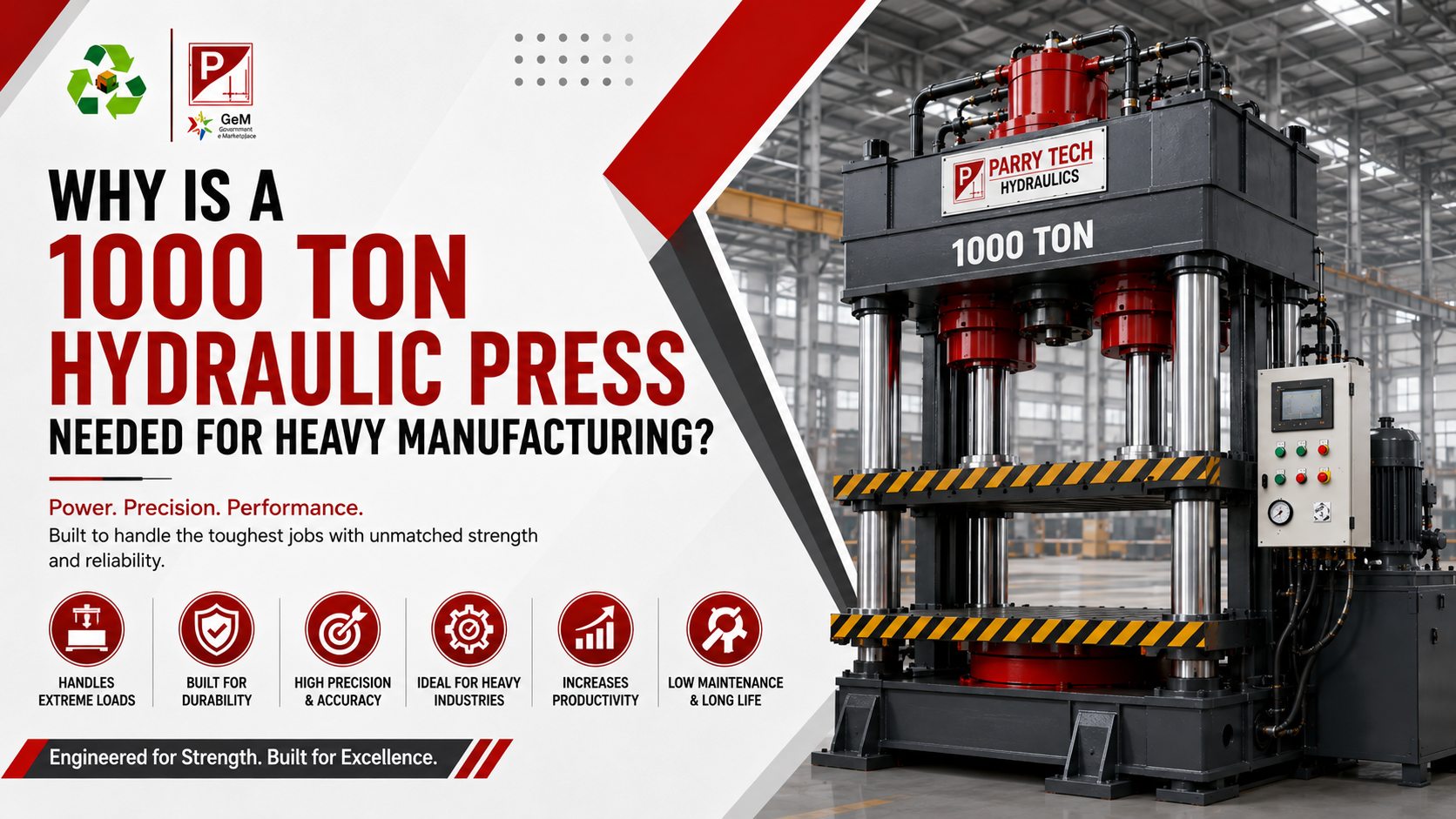
A 1000 Ton Hydraulic Press is designed for heavy-duty industrial applications where high and controlled forming force is required. It can support manufacturing processes such as deep drawing, metal forming, moulding, pressing, and other operations involving large or high-strength components. However, selecting a 1000-ton machine should not be based on tonnage alone. The material, component size, tooling, stroke, daylight, production cycle, and required hydraulic control all need to be considered.
For manufacturers searching for the Best 1000 Ton Hydraulic Press in Delhi, Parrytech Hydraulics provides high-capacity hydraulic press solutions that can be configured according to specific production requirements. Its published hydraulic deep-draw press range includes a 1000-ton configuration and states that higher-capacity presses can also be manufactured according to customer requirements.
What Is a 1000 Ton Hydraulic Press?
A 1000-ton hydraulic press is a heavy-duty machine capable of applying a maximum hydraulic force of approximately 1000 tons under its specified operating conditions. The actual machine design can vary depending on whether it is intended for deep drawing, moulding, pressing, forming, or another industrial process.
Hydraulic pressure is generated by the power unit and transferred through hydraulic cylinders to produce the required pressing force. Compared with mechanical presses, hydraulic systems provide useful control over pressure and ram movement, which can be important when different materials or forming depths need to be handled.
Parrytech’s hydraulic deep-draw press with blank holder includes a 1000-ton configuration with a 500 + 500 ton arrangement, 1200 mm platen size, 1100 mm daylight, 500 mm main-cylinder stroke, 600-ton blank-holder capacity, and a 2200 × 2200 mm bed in its published specifications.
How Does It Support Industrial Production?
1. Handles Heavy Forming Operations
The biggest advantage of a 1000-ton press is its ability to provide substantial forming force. This makes it suitable for applications where smaller presses cannot provide the required pressure.
Depending on the machine configuration, it can be used for large sheet-metal components, deep-drawn products, industrial forming, heavy moulding, and other demanding applications.
The correct force requirement should always be calculated from the actual component and process. A manufacturer should not automatically choose 1000 tons simply because it is a high-capacity machine.
2. Supports Deep-Drawing Applications
Deep drawing is one area where high-capacity hydraulic presses can be particularly useful. During deep drawing, the material needs to flow into the die while maintaining the desired component shape.
A blank holder or die cushion can help control this material movement. Parrytech’s 1000-ton deep-draw configurations demonstrate the use of dedicated blank-holder and die-cushion arrangements for different forming requirements. Its published die-cushion model FDCP-1000 has a 1000-ton main capacity, 1800 × 1800 mm platen, 1200 mm daylight, 750 mm main-cylinder stroke, and 400-ton die-cushion capacity.
3. Produces Large Components
Large components require sufficient working space around the tooling. A press may have adequate tonnage but still be unsuitable if the bed, platen, stroke, or daylight is insufficient.
This is why Parrytech’s published specifications provide information on platen size, daylight, stroke, and auxiliary forming capacity alongside tonnage. These specifications allow manufacturers to evaluate the machine against their actual tooling and component requirements.
4. Provides Controlled Hydraulic Movement
Hydraulic pressing allows the operator or control system to manage the pressing cycle according to the application. This is useful when the forming operation requires controlled movement rather than simply applying maximum force.
For automated industrial production, PLC-based controls can help manage repeatable operating sequences. Parrytech offers PLC-controlled hydraulic press configurations, including its 1000-ton melamine crockery hydraulic press, which is listed with a 1000 × 800 mm bed and 900 mm daylight.
5. Supports Different Manufacturing Industries
A 1000-ton hydraulic press can be configured for different industrial applications. Depending on the tooling and machine design, applications can include:
- Deep drawing
- Steel utensil manufacturing
- Automobile component forming
- Rubber moulding
- Plastic and composite moulding
- Heavy-duty metal forming
- Industrial pressing
- Large component shaping
Parrytech states that its hydraulic deep-drawing presses are used for products such as steel utensils and automobile components, while its broader product range includes rubber moulding presses, transfer moulding presses, hydraulic presses, and other industrial hydraulic equipment.
Important Features to Check Before Buying
A 1000-ton rating is only one part of the machine specification. Manufacturers should carefully examine the following:
Press Capacity
Confirm that the required forming force falls within the machine’s working capacity and that sufficient capacity is available for the intended process.
Bed or Platen Size
The bed must accommodate the complete die and tooling arrangement. Large components may require a considerably larger working area.
Stroke Length
The stroke determines how far the ram can travel during the forming cycle. Deep-drawing applications may require longer strokes.
Daylight
Adequate daylight is necessary to accommodate the die, punch, workpiece, and tooling arrangement.
Blank Holder or Die Cushion
For deep drawing, controlling material flow is important. The appropriate blank-holder or die-cushion capacity should therefore be considered alongside the main press capacity.
Hydraulic System
Pumps, cylinders, valves, filters, oil tank capacity, pressure settings, and cooling arrangements all influence machine performance and reliability.
Control System
PLC and HMI-based control can make repeated production cycles easier to manage and monitor, particularly in automated production environments.
Why Choose Parrytech Hydraulics?
Parrytech Hydraulics manufactures hydraulic machinery from its facility in Mundka Industrial Area, New Delhi, and offers equipment including hydraulic presses, deep-draw presses, rubber moulding presses, transfer moulding units, baling machines, and hydraulic cylinders.
The company focuses on application-specific hydraulic engineering rather than treating every machine requirement identically. Its published 1000-ton deep-draw configurations show that specifications can include different platen sizes, daylight, stroke lengths, blank-holder or die-cushion capacities, and motor requirements depending on the machine type.
Parrytech also states that heavy-duty presses are available and that presses can be manufactured according to customer requirements. This is important for manufacturers whose component dimensions, tooling, material, or production process do not fit a standard machine configuration.
The company’s website also highlights quality checks, precision engineering, timely delivery, maintenance alerts, and upgrade options as part of its manufacturing approach.
For customers looking for the Best 1000 Ton Hydraulic Press in Delhi, local manufacturing support can also be useful for technical discussions, machine inspection, installation coordination, commissioning, and future service requirements. Parrytech Hydraulics
How to Select the Right 1000 Ton Press?
Before ordering the machine, manufacturers should provide the press manufacturer with as much application information as possible:
- Material type and thickness
- Component drawing or dimensions
- Required forming depth
- Required pressing force
- Die dimensions
- Required stroke
- Production quantity
- Desired cycle time
- Blank-holder or die-cushion requirement
- Automation requirements
- Available factory space
This information allows the manufacturer to determine whether a 1000-ton configuration is actually suitable and which additional features should be incorporated.
Final Thoughts
A 1000 Ton Hydraulic Press can provide the high forming force, controlled hydraulic movement, and working capacity required for demanding industrial production. Its effectiveness, however, depends on correct machine selection, tooling, hydraulic configuration, and process settings.
For deep drawing and complex forming, features such as blank-holder capacity, die cushion, stroke, daylight, and platen size can be just as important as the 1000-ton rating itself.
For manufacturers searching for the Best 1000 Ton Hydraulic Press in Delhi, Parrytech Hydraulics offers high-capacity hydraulic press configurations and custom manufacturing options. Discussing the component, material, tooling, and production requirements with the manufacturer before finalizing the machine is the best way to achieve a suitable industrial solution.
FAQs
1. What is a 1000 Ton Hydraulic Press used for?
It is used for heavy-duty pressing, deep drawing, moulding, metal forming, and other industrial applications requiring high hydraulic force.
2. Can a 1000-ton press handle deep drawing?
Yes. With suitable tooling and blank-holder or die-cushion arrangements, it can be used for demanding deep-drawing applications.
3. Can Parrytech manufacture a 1000-ton press?
Yes. Parrytech lists 1000-ton hydraulic press configurations and states that machines can be manufactured according to customer requirements.
4. What should I check before buying?
Check tonnage, bed size, stroke, daylight, hydraulic system, blank-holder or die-cushion capacity, controls, and tooling requirements.
5. Where is Parrytech Hydraulics located?
Parrytech Hydraulics is located in Mundka Industrial Area, New Delhi, India.

Leave A Comment