
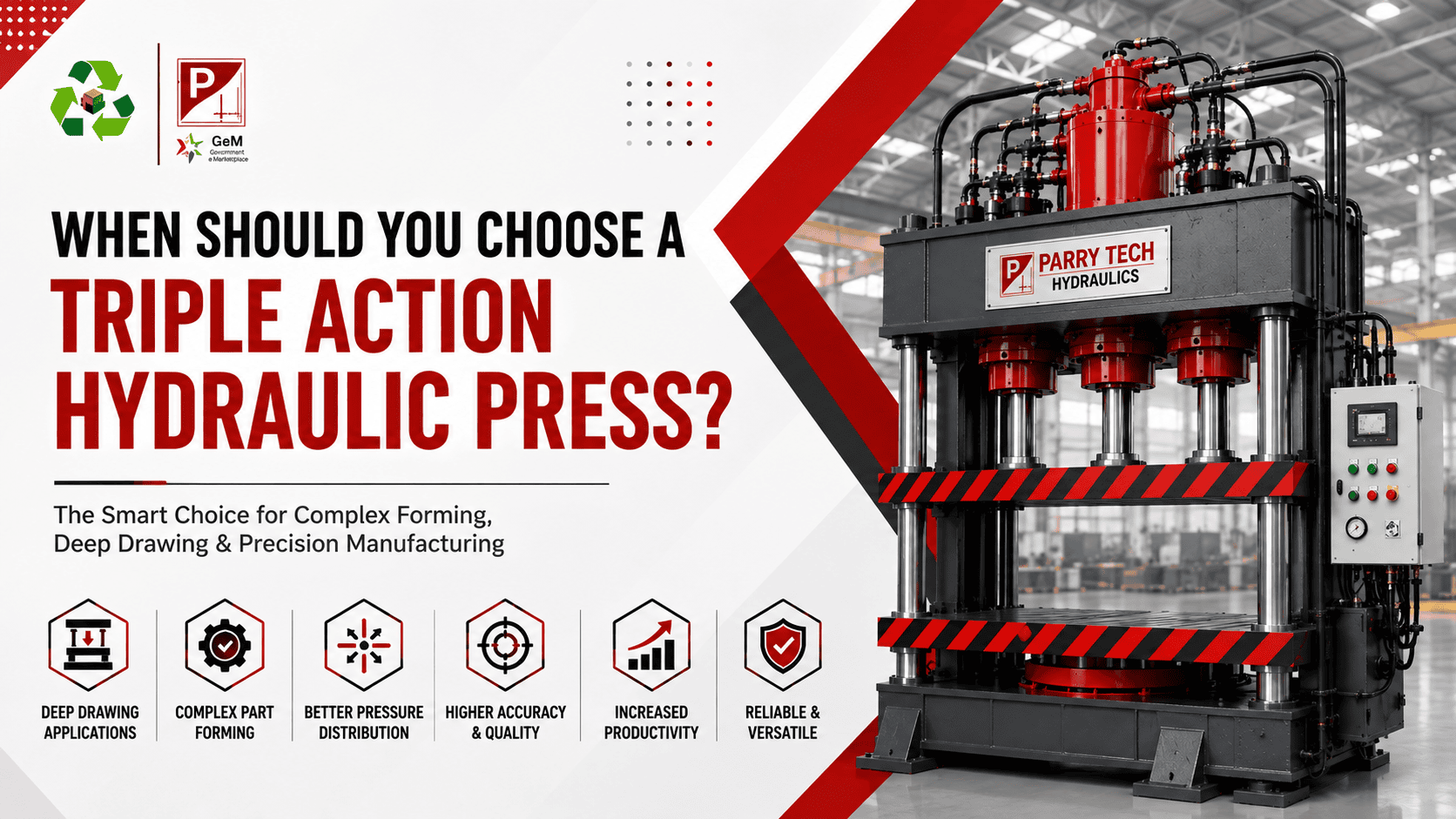
A Triple Action Hydraulic Press is used when a manufacturing process requires more controlled forming than a conventional single-action or double-action press can provide. The additional hydraulic action gives the manufacturer greater control over the workpiece, tooling, and forming sequence. This makes triple-action technology useful for demanding applications such as deep drawing, complex sheet-metal forming, and components that require controlled material movement from more than one direction.
For manufacturers searching for a Triple Action Hydraulic Press in Delhi, the important question is not simply whether the machine has three hydraulic actions. The machine should be selected according to the material, component geometry, drawing depth, required force, die arrangement, production volume, and level of automation.
What Is a Triple Action Hydraulic Press?
A triple-action hydraulic press uses three separately controlled hydraulic movements to perform a forming operation. Depending on the machine design and application, these actions can control the main ram, blank holder, and another forming or die-related movement.
The additional action becomes useful when the manufacturing process involves complicated forming sequences or requires greater control over the material and tooling. Instead of relying on one pressing movement, the machine can coordinate multiple hydraulic actions during the production cycle.
Parrytech Hydraulics manufactures a wide range of hydraulic machinery, including hydraulic presses, deep-drawing presses, special-purpose hydraulic presses, four-pillar presses, preforming presses, and other customized hydraulic equipment. Its product range also includes hydraulic baling machines with triple-action hydraulic systems.
When Should You Choose a Triple Action Hydraulic Press?
1. When the Component Has Complex Geometry
If the component has multiple contours, deeper sections, or difficult forming areas, controlling the material with a basic press can become challenging.
A triple-action arrangement can provide additional control during the forming cycle. This can help manufacturers manage the movement of the workpiece and tooling more effectively.
Before selecting the machine, engineers should study the component drawing and determine where each hydraulic action will be required.
2. When Better Material Flow Control Is Needed
Material flow is one of the most important considerations in sheet-metal forming. During deep drawing, the sheet must move into the die without excessive wrinkling or tearing.
With additional hydraulic control, the manufacturer can manage different stages of the forming process more accurately. The actual pressure and movement settings still need to be established according to the material, thickness, tooling, and component design.
This is one reason experienced machine manufacturers look at the complete forming process instead of recommending equipment only according to tonnage.
3. When Double Action Is Not Enough
A double-action press can provide separate control of the main ram and blank holder, which is sufficient for many deep-drawing applications.
However, some components require an additional controlled movement. In such cases, a triple-action configuration can provide another hydraulic function that may be integrated into the tooling or forming sequence.
The decision should therefore be based on the actual production requirement. If two hydraulic actions can perform the job effectively, a triple-action machine may not be necessary. If the tooling requires a third controlled movement, it can provide a significant advantage.
Applications of Triple Action Hydraulic Presses
Triple-action hydraulic technology can be considered for demanding forming and specialized industrial operations such as:
- Complex sheet-metal forming
- Deep drawing
- Automobile components
- Kitchen and cookware components
- Industrial metal components
- Special-purpose forming
- Components requiring controlled multi-stage forming
- Applications requiring additional die movement
Parrytech Hydraulics’ product range includes dedicated hydraulic deep-drawing presses for applications such as kitchen sinks, cooking hobs, cooker manufacturing, fire extinguishers, and industrial deep drawing.
The appropriate machine configuration depends on the component and tooling. A triple-action system should be considered when the manufacturing process genuinely benefits from the additional hydraulic movement.
Triple Action vs Double Action Hydraulic Press
The main difference is the number of independently controlled hydraulic actions available during the forming process.
A double-action press generally provides two primary movements, commonly the main ram and blank holder. It is suitable for many deep-drawing and sheet-forming applications.
A triple-action press adds another controlled hydraulic movement. This can be valuable when the die or component requires an additional forming, holding, or controlled movement.
The correct choice should therefore be based on:
- Component complexity
- Die construction
- Required forming sequence
- Material flow
- Drawing depth
- Required pressure
- Production volume
- Automation requirements
Choosing a triple-action machine simply because it offers an additional action does not automatically make it better. The third action should have a practical purpose within the production process.
What Features Should Manufacturers Check?
Hydraulic Control
The hydraulic system should provide stable and controllable pressure for all required actions. Pumps, valves, cylinders, filtration, oil capacity, and pressure-control components should be selected according to the machine’s working requirements.
Machine Tonnage
Tonnage should be determined from the actual forming force required. Material type, thickness, blank dimensions, component geometry, and tooling all influence the required capacity.
Stroke
The available stroke must be sufficient for the complete forming operation. If the stroke is inadequate, the machine may not be able to complete the required forming cycle.
Bed and Die Size
The machine bed should accommodate the die safely with sufficient working area. The complete tooling arrangement should be considered before selecting the press.
Control System
PLC-based controls can help coordinate multiple hydraulic actions and provide repeatable operating sequences. This becomes increasingly important when the forming process involves several controlled movements.
Safety and Maintenance
A complex hydraulic system requires proper installation, commissioning, inspection, and preventive maintenance. Hydraulic leakage, pressure fluctuations, damaged seals, and incorrect settings can affect both machine operation and product quality.
Why Choose Parrytech Hydraulics?
Parrytech Hydraulics is based in Mundka Industrial Area, New Delhi, and manufactures a broad range of hydraulic machinery for industrial applications. Its product portfolio includes hydraulic presses, hydraulic deep-drawing machines, moulding presses, shearing machines, bending machines, baling presses, hydraulic cylinders, and power packs.
The company’s experience across different hydraulic applications is particularly useful when a manufacturer needs a machine for a specific forming process. Instead of looking only at the press capacity, the application can be evaluated around the component, tooling, hydraulic force, stroke, and required production sequence.
Parrytech also offers special-purpose hydraulic press solutions, which can be important when a standard machine configuration does not match the customer’s manufacturing process.
For businesses searching for a Triple Action Hydraulic Press in Delhi, having a local manufacturer can also make technical discussions, machine inspection, installation planning, commissioning, and service coordination more convenient.
The company is located in Mundka Industrial Area, New Delhi, where several hydraulic and industrial machinery manufacturers operate. Parrytech Hydraulics
How to Know If You Really Need Triple Action?
Before purchasing, manufacturers should answer a few practical questions:
- Does the component require more than two controlled hydraulic movements?
- Does the die require an additional hydraulic action?
- Is material flow difficult to control with the existing press?
- Does the forming sequence involve multiple stages?
- Is the component geometry too complex for a double-action configuration?
- What blank-holder and forming forces are required?
- What stroke and daylight are required?
- What level of automation is expected?
- Can the existing tooling be adapted to the proposed machine?
- What installation and maintenance support will be required?
If the answer to these questions indicates that an additional controlled movement is necessary, a triple-action press may be the appropriate solution.
Final Thoughts
A Triple Action Hydraulic Press should be chosen when the manufacturing process requires an additional controlled hydraulic movement that cannot be effectively achieved with a single-action or double-action machine.
It can be particularly useful for complex forming, demanding deep-drawing operations, specialized tooling, and applications where precise control over different stages of the forming process is important.
However, more hydraulic actions do not automatically mean better production. The machine must be correctly matched with the material, component, die, tonnage, stroke, hydraulic system, and production requirements.
For manufacturers looking for a Triple Action Hydraulic Press in Delhi, discussing the actual component drawing and tooling requirements with an experienced hydraulic machinery manufacturer is the best way to determine whether triple-action technology is genuinely required.
FAQs
1. What is a Triple Action Hydraulic Press?
It is a hydraulic press with three controlled hydraulic movements for demanding forming applications.
2. When is triple action better than double action?
It is useful when the forming process or tooling requires an additional controlled hydraulic movement.
3. Is it suitable for deep drawing?
Yes, triple-action technology can be used for demanding deep-drawing and complex forming applications.
4. Can the machine be customized?
Yes. Hydraulic presses can be developed according to specific application and production requirements.
5. Why choose Parrytech Hydraulics?
Parrytech offers a broad range of hydraulic machinery and application-focused hydraulic solutions from its manufacturing base in New Delhi.

Leave A Comment