
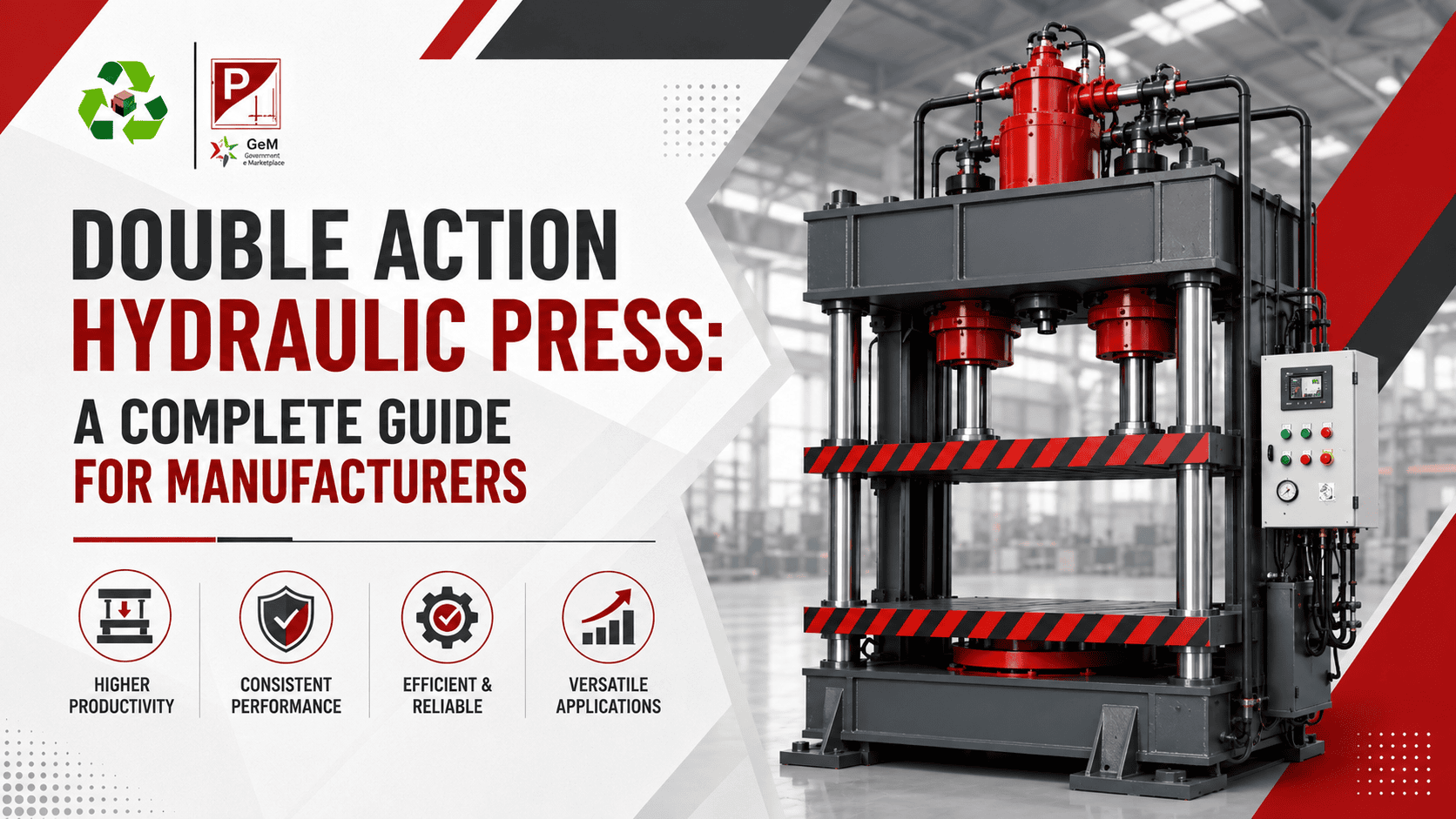
A Double Action Hydraulic Press is designed for manufacturing operations where controlled forming, deep drawing, and consistent pressure are required. Unlike a basic single-action press, a double-action system generally uses separate movements for the main ram and blank holder. This provides better control over the workpiece during forming and is especially useful for sheet-metal components with deeper or more complicated shapes.
For manufacturers searching for a Double Action Hydraulic Press in Delhi, selecting the machine should involve more than checking tonnage. Material type, component dimensions, drawing depth, die size, blank-holder force, stroke, daylight, production volume, and automation requirements all need to be considered before finalizing the machine.
What Is a Double Action Hydraulic Press?
A double-action hydraulic press uses two hydraulic actions during the forming cycle. The primary ram applies the main forming force, while the second action controls the blank holder. During deep drawing, the blank holder keeps the sheet properly positioned while the punch moves the material into the die.
This controlled material movement is one of the main reasons manufacturers use double-action presses for demanding forming applications. Incorrect blank-holder pressure can lead to problems such as wrinkles, excessive thinning, or inconsistent component shapes. Therefore, the hydraulic system and die arrangement need to be selected according to the actual application.
Parrytech Hydraulics manufactures double-action hydraulic deep-draw presses in different capacities. Its published specifications range from 100-ton to 1000-ton models, with heavy-duty deep-drawing presses available up to 4000 tons. The company also states that presses can be manufactured according to customer requirements.
How Does a Double Action Hydraulic Press Work?
The operating cycle starts when the workpiece or metal blank is positioned over the die. The hydraulic power unit supplies pressurized oil to the cylinders to generate the required force.
The blank holder first applies controlled pressure to the material. The main ram then moves the punch downward, forcing the sheet into the die cavity. During this movement, the blank holder controls the flow of material and helps maintain the required shape.
Once the forming operation is completed, the hydraulic system controls the return movement of the ram and blank holder. The exact sequence can be adjusted according to the component, material, die arrangement, and production requirements.
Parrytech’s double-action deep-draw press specifications include PLC-controlled operation, Yuken/Rexroth solenoid valves, Polyhydron pre-fill valves, and ABB/Havells motors. Its listed models operate at a working pressure of 210 bar, with different combinations of capacity, stroke, daylight, blank-holder capacity, and platen size.
Main Components of a Double Action Hydraulic Press
Understanding the main components helps manufacturers evaluate a machine before purchase.
Hydraulic Cylinders
The cylinders generate the pressing and blank-holder forces. Their capacity and stroke must match the required forming operation.
Main Ram
The main ram carries the punch and provides the primary forming force required to shape the workpiece.
Blank Holder
The blank holder controls the sheet during deep drawing. Its pressure needs to be suitable for the material and component geometry.
Hydraulic Power Unit
The hydraulic power unit supplies pressurized oil to operate the cylinders. Pump selection, pressure, oil capacity, valves, and filtration all contribute to reliable machine operation.
PLC Control System
A PLC can control the machine sequence and make repeated production cycles more consistent. Parrytech’s double-action deep-draw press is listed with PLC-controlled operation.
Die and Platen Area
The platen or bed size determines the available working area for tooling. Manufacturers should ensure that the machine’s bed dimensions are compatible with the required die.
Applications of Double Action Hydraulic Press
Double-action presses are widely used for industrial forming and deep-drawing applications. Typical uses include:
- Kitchen sink manufacturing
- Cooking hob production
- Cooker and cookware components
- Automobile components
- Fire extinguisher bodies
- Metal containers
- Electrical components
- Sheet-metal forming
- Industrial deep-drawn parts
Parrytech Hydraulics offers a broad range of deep-drawing equipment, including presses with blank holders, die cushions, industrial deep-drawing systems, cooking hob presses, SS kitchen sink presses, and fire-extinguisher deep-draw presses.
This variety is useful for manufacturers because different components require different forming arrangements. A sink, for example, may have very different drawing requirements from an automobile or industrial component.
Benefits for Manufacturers
Better Control of Material Flow
The blank holder provides additional control over the sheet during forming. This is particularly valuable for deep-drawing operations.
Consistent Production
Once suitable hydraulic pressure, stroke, speed, and blank-holder settings are established, the machine can repeat the forming cycle consistently.
Suitable for Deep Drawing
The separate hydraulic actions make the press suitable for applications where controlling material movement is important.
Flexible Capacity Options
Manufacturers can select machine capacity according to the required forming force. Parrytech’s published range demonstrates configurations from 100 tons through 1000 tons, with higher-capacity presses available for heavy-duty requirements.
Custom Machine Configuration
Production requirements vary from one manufacturer to another. For this reason, factors such as bed size, stroke, daylight, blank-holder capacity, motor power, and control system can be selected according to the application.
Improved Process Control
PLC-based controls can help operators manage machine sequences and repeat production cycles more efficiently.
What Should Manufacturers Check Before Buying?
Choosing a hydraulic press only by its tonnage can create problems later. Manufacturers should evaluate the complete application.
1. Material: Identify whether the machine will process mild steel, stainless steel, aluminium, or another material.
2. Component size: The finished component dimensions influence the required bed and die size.
3. Drawing depth: Deeper components may require greater stroke and better blank-holder control.
4. Required force: Calculate the forming force instead of automatically selecting the highest available tonnage.
5. Blank-holder force: Ensure that the blank-holder capacity is suitable for the material and tooling.
6. Stroke and daylight: These determine whether the required die and component can be accommodated.
7. Automation: Decide whether manual, semi-automatic, or PLC-controlled operation is appropriate.
8. Hydraulic components: Check pumps, valves, cylinders, filtration, oil tank, and pressure-control arrangements.
9. After-sales support: Installation, commissioning, maintenance, training, and breakdown support should also be considered.
These practical factors help manufacturers select a machine that fits the production process instead of purchasing a press based on capacity alone.
Why Choose Parrytech Hydraulics?
Parrytech Hydraulics has its manufacturing facility in Mundka Industrial Area, New Delhi, and specializes in hydraulic presses, deep-drawing presses, rubber moulding machines, transfer moulding units, baling machines, and other hydraulic equipment.
The company focuses on application-based hydraulic machinery rather than offering only one standard press configuration. Its published double-action press specifications show multiple capacity options, different bed sizes, stroke lengths, blank-holder capacities, and motor requirements. This allows the machine configuration to be matched more closely with the customer’s production application.
Parrytech also states that its presses are manufactured according to customer requirements. For a manufacturer, this is important because tooling dimensions, component geometry, drawing depth, production quantity, and available factory space can differ significantly between applications.
The company provides hydraulic machinery from its Delhi manufacturing base, making local coordination easier for customers requiring machine discussions, inspection, installation, commissioning, and service support.
For manufacturers searching for a Double Action Hydraulic Press in Delhi, evaluating the manufacturer’s engineering capability, machine configuration, hydraulic components, testing process, and post-installation support can be just as important as comparing machine capacity.
Installation and Maintenance Matter
A hydraulic press needs proper installation before it enters regular production. Hydraulic connections, electrical controls, machine alignment, pressure settings, cylinder operation, and safety functions should be checked during commissioning.
Regular maintenance is equally important. Hydraulic oil condition, filters, seals, valves, cylinders, electrical controls, and connections should be inspected according to the operating environment and machine requirements.
For heavy-duty production, preventive maintenance can help identify hydraulic leakage, pressure fluctuations, abnormal cylinder movement, or other issues before they affect production.
Final Thoughts
A Double Action Hydraulic Press is a valuable solution for manufacturers involved in deep drawing and controlled sheet-metal forming. Its separate main-ram and blank-holder actions provide better control over material movement and make the machine suitable for a wide range of industrial applications.
The correct machine should be selected according to the material, component size, drawing depth, required force, blank-holder pressure, stroke, daylight, die dimensions, production volume, and automation requirements.
For businesses looking for a Double Action Hydraulic Press in Delhi, Parrytech Hydraulics offers different hydraulic press configurations and custom manufacturing options. Discussing the actual component and production process with the manufacturer before finalizing the machine can help ensure that the selected press is technically suitable for the intended application.
FAQs
1. What is a Double Action Hydraulic Press?
It is a hydraulic press with separate main-ram and blank-holder actions for controlled forming and deep drawing.
2. What is a double-action press used for?
It is commonly used for deep drawing, kitchen sinks, cooking hobs, cookware, automobile parts, and industrial sheet-metal components.
3. What tonnage is available?
Parrytech lists double-action deep-draw presses from 100 tons to 1000 tons, with heavy-duty capacities available up to 4000 tons.
4. Can Parrytech customize the press?
Yes. The company states that presses can be manufactured according to customer requirements.
5. Where is Parrytech Hydraulics located?
Parrytech Hydraulics is located in Mundka Industrial Area, New Delhi, India.

Leave A Comment